

Now imagine being colorblind…
That’s what always bothered me about exams. They’re always about what the examiner wants to hear and not about what is right.
For me, it was always where the teacher had to add their own flair and/or questions on top of the textbook ones. They were always the most ambiguous to answer, and cost everyone points. Of course, in American public school, we’re not taught to challenge our elders and call bullshit when we see it. So everyone takes the -5% on the chin, except that one kid that accidentally got that one right.
Go into a Math based field. No more trying to read your professor’s personalities to figure out what their opinions are so you can bullshit them into a good grade. Just cold, hard numbers. Often many ways to get to the same answer, but at the end, you are either right, or you are wrong.
I can’t stand subjective questions. How the fuck are you going to tell me that my interpretation of an abstract concept is wrong?! I’ll stick with numbers, thank you.
I found my people. I always did well in English class, but I hated it, and liked math and science more for that exact reason. There is no intepretation or better answer, there is a exact method to get the right answer and you can easily check/prove why you’re right. No tricks or suprises, what you see is what you get, purely facts.
Now, I can write essays just fine, and I even enjoy them if it’s a topic I choose to write about. But those shitty standards of learning tests that we’d do in grade school fucking killed me. I was so suprised that I liked my college Lit course, we didn’t do bullshit like that, it was all about group discussion and intepretation of what we read that day.
Teaching just to meet standards really needs HEAVY reform/revision.
sounds like you went to a bad school. not all of us had that experience.
So just put what the examiner is thinking, obviously
School trains you for real life. Repeat back what your boss told you, in a confident enough way to make it sound like you understand what’s happening.
Exactly
Pick the gender fluid one.
deleted by creator
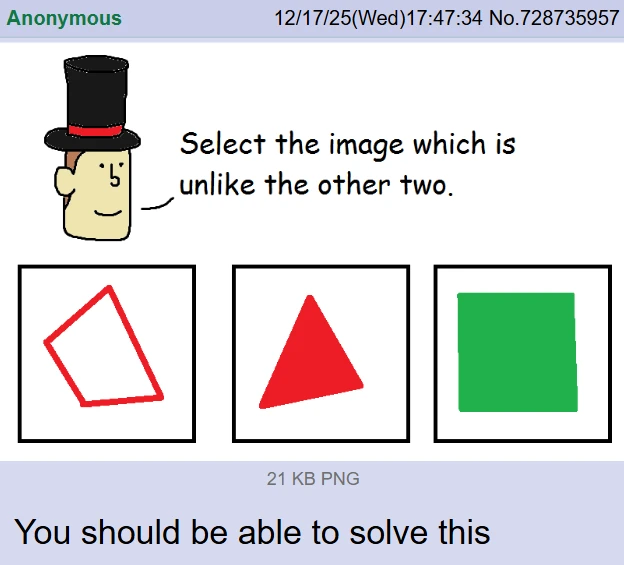
B only has three corners
I would go with C, because:
A) Not filled
B) Doesn’t have 4 sides/corners (or sum of angles is less than 360 deg.)
C) Isn’t red AND the only shape with all right(ish) anglesSo C is most unlike the others.
C does have 4 sides and 4 corners and all of its corners add up to 360°, same as A since the interior angles of all quadrilaterals add up to 360°
C is regular, A and B are irregular
Yes, that’s exactly what I said. B doesn’t have those things you mentioned, meaning A and C do.
I think OP is saying it doesn’t have smooth sides or corners and is not a quad at all, but actually an irregular polygon due to the jittered sides and overlapping corners.
I would also go with C, but for different reasons:
A) is the only one not filled in
B) is the only three sided
C) can partner easily with A and Bso C because he’s the most chill
But all of them can equally be partnered with any other, because if you don’t count the right angle difference they all have the same amount of differences and are equally “chill”.
Oh! I genuinely did not notice color. Fair point.
I still think Rectangle-chan gives spicy BigBoi vibes that I jell with more, but I respect the correction
Green color and less pointy corners definitely makes it look more friendly.

That’s easy. The answer is A: 2024. The other answers would require either the zero or the four to be plural.
Yeah, if you understand the basics of the English language. Many English and foreign-English native speakers don’t, and that makes their learning that much more spicy
I honestly feel bad for anyone who has to learn English as anything other than their first language. I don’t know if there’s any other languages where there are so many exceptions to every rule of pronunciation, spelling, and grammar.
B: 0044 is both plural which is as consistent as A: 2024
I think he’s saying that the clue would need to be “two zeroes, two fours”
optimism : every answer is right
Pessimism : every answer is wrongPhysicists: all three answers are both right and wrong up until the point when they are evaluated.
Schrodingers multiple choice?
Reminds of the game Set. It’s a card game, but there are many online versions. I loved this game while growing up.
Numberphile did a video about this game and to my recollection the person presenting it actually had a distinct game of set they and their math friends would play. It was pretty interesting!
Good game
I played this as a card game so much in high school. Real nice with an online version. Thank you.
This new captcha is less annoying than the one before
I gave up posting last night after failing 3 times in a row.
I could see 1 or 3 being the answer. But not 2.
2 has 3 sides instead of 4
… only one choice is green.
How is this difficult, other than if you are r/g colorblind?
The correct choice is C.
If you pick A, B is also red, and C is also an irregular 4-gon. So A is not unlike either B or C.
If you pick B, A is also red, and C is also filled solid with color. So B is not unlike either B or C.
But if you pick C, while C does have elements in common with A and B…
(it shares ‘irregular 4-gon’ with A, and ‘solid color fill’ with B)
… it is also unlike each of them singly, as well as both of them together, in that it is green.
C is the only choice where ‘is unlike the other two’… is true, in any sense.
It has a distinct property, not found in any member of the remainder set, nor shared by the remainder set as a group.
… only one choice is a triangle.
How is this difficult, other than if you are shape blind?
The correct choice is B.
If you pick A, B is also red, and C is also an irregular 4-gon. So A is not unlike either B or C.
If you pick C, A is also an irregular 4-gon, and B is also filled solid with color. So C is not unlike either A or B.
But if you pick B, while B does have elements in common with A and C…
(it shares ‘red’ with A, and ‘solid color fill’ with C)
… it is also unlike each of them singly, as well as both of them together, in that it is a triangle.
B is the only choice where ‘is unlike the other two’… is true, in any sense.
It has a distinct property, not found in any member of the remainder set, nor shared by the remainder set as a group.
What a fool you are!
… only one choice is an outline.
How is this difficult, other than if you are line blind?
The correct choice is A.
If you pick B, A is also red, and C is also a filled solid. So B is not unlike either A or C.
If you pick C, A is also an irregular 4-gon, and B is also filled solid with color. So C is not unlike either A or B.
But if you pick A, while A does have elements in common with B and C…
(it shares ‘red’ with B, and ‘4-gon’ with C)
… it is also unlike each of them singly, as well as both of them together, in that it is a triangle.
A is the only choice where ‘is unlike the other two’… is true, in any sense.
It has a distinct property, not found in any member of the remainder set, nor shared by the remainder set as a group.
Welp.
I tap out, you’re right lol.
Don’t attempt set theory before breakfast, otherwise you end up making a fool of yourself as I have.
=[
Hangry is not a useful state to approach logic from.
2 shapes are the same colour
2 shapes are filled
2 shapes have four sides
the point of this is that there are multiple distinct properties not found in any member of the remainder set
deleted by creator
No.
You are wrong.
“Select the image that is unlike the other two.”
The only possible choice that results in a set of 2, and a set of 1, which are seperated cleanly by a distinct property, is picking C.
The goal is to define a difference between potential sets such that a distinct property exists between the two sets that you create.
To define two sets where unlikeness exists between them when they are compared.
Your job is not to merely compare three elements.
It is to compare three possible pairs of sets that can be made out of three elements.
Which elements have which particular combinations of attributes is thus very important, not irrelevant, as your simplified description of the situation portrays.
And that’s literally what they did.
There’s a set of shapes that are filled, and a distinct set of one that is outline only.
There’s a set of shapes that have 4 sides, and a distinct set of one that is 3 sides only.
There’s a set of shapes that are red, and a distinct set of one shape that is green.
If you pick A, B is also red, and C is also an irregular 4-gon. So A is not unlike either B or C.
If you pick B, A is also red, and C is also filled solid with color. So B is not unlike either B or C.
But if you pick C, while C does have elements in common with A and B…
(it shares ‘irregular 4-gon’ with A, and ‘solid color fill’ with B)
… it is also unlike each of them singly, as well as both of them together, in that it is green.
Only when you pick C do you result in a pair of sets that are cleanly dvided by the same property difference.
Is that more clear?
If you pick C, the distinction between C and A is the same distinction between C and B.
Thus, if you pick C, C is unlike A and B in the same way.
This is what I would call a clean or clear distinction, or … kind of unlikeness.
This is not the case, does not occur, if you pick A or B.
You end up with a picked set of one element that differs from the remainder set in ways that are inconsistent among the elements of the remainder set.
IE, a muddled or inconsistent distinction.
No, you’re still not correct just because you chose to reduce the similarities of C with A and B.
Again, I can make the same ignorant reduction of importance you did, but from a different aspect, and get a different answer.
The only reason you’re picking C is psychological, as in, C is the most visually distinct due to the difference in colour (which is something human eyes are keyed towards). The rest of your explanation is a pseudointellectual attempt of forcing logic into your subjective choice, basically, you’re Petersoning it real hard just to be right.
Just to make it clear, let’s apply your same property difference.
If you pick A, the distinction between (A, B) and (A, C) is the same - they are filled, not outline.
If you pick B, the distinction between (B, A) and (B, C) is the same again - they have four sides, not 3.
So, again, the same property difference pair can be applied to literally any of the choices.
Yep, you’re right.
KaChilde ran through a more thorough version of my own logic and I realized I am being a stubborn ass, sorry about that lol!
Well, I’m glad this moment led to some personal growth!
Remember, making mistakes is okay as long as you 1, can admit being wrong and 2, learn from being wrong.
And to be fair this “puzzle” is specifically designed to be confusing and have people jump to the “obvious conclusion” based on their perspective. To you it was the colour green vs red, to others it was the shape triangle vs quadrangle, and to a third group it would be the outline vs filled state. It’s actually not unlike some IQ test questions where the goal isn’t to see if you can find the “correct” answer (as there isn’t one!), but to see how you think.
I think you are overthinking this mate.
I concur, and realized my logic is flawed.
… sorry.