

Archived copies of the article:
The details on this are not promising:
Nearly 23% of new vehicles sold in California in 2025 were considered zero-emission vehicles, though EV sales were down in the state and across the U.S. compared to the year prior.
…
In the fourth quarter of 2025, only 18% of new cars sold in the state were zero-emission.
It needs to be 100% in the not-very-distant future, and that’s going to be really tough without a sharp reduction in prices, which isn’t likely to happen due to tariffs pushing prices up.
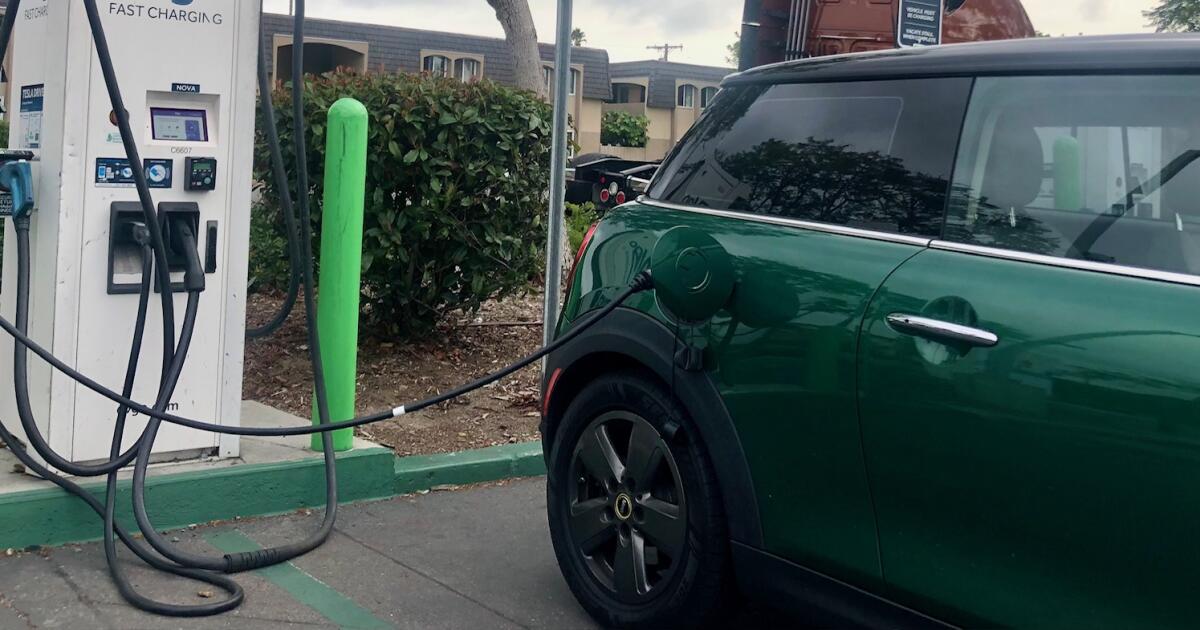
EV charging Infra is actually pretty good statewide these days, and battery range isn’t bad. (I drive an EV regularly). The real challenge for EV sales is that fueling an EV has gotten more expensive than fueling a comparable gas car.
Agree on car reliance though. We’ve neglected building decent transit systems for generations.
The infrastructure is pretty good in California, sure, but I was thinking more about the US as a whole.
Also, the problem with lithium-ion battery tech isn’t just the range - it’s the charging speeds, and the weight/cost of the battery packs themselves.
Ah, yeah, I missed that you referred to America. We do have it pretty good here in CA, and my use case is favorable for an EV. I’m able to charge at home, and rarely need to charge en route to get somewhere. Those few occasions when I do, the 10 mins to charge up isn’t a big deal. If I couldn’t charge at home, or regularly took very long trips, the EV wouldn’t make sense.
As for the weight… I just looked and my EV (a model 3) is 50 pounds heavier than my other car (a Lexus hybird sedan). That’s a pretty negligible difference. It’s about 500 pounds heavier than the Honda accord I used to have. That’s a more material difference, but not as big a deal as people online make it out to be.
Precisely. Until the ease of refuelling becomes more competitive with ICE cars for the average user, EVs are not going to see mass adoption.
The weight difference between an EV and a HEV/PHEV usually isn’t as dramatic as between an EV and an ICE vehicle. Plus you’re not comparing like with like (Tesla vs Lexus). A better comparison would be, for example, the Hyundai Kona EV (curb weight 3,803 lb) versus the gasoline Kona (2,855 lbs) - Source. That’s nearly 1,000 lbs of extra weight due to the battery pack and hardware.
All that extra weight means more power required for propulsion, which in turn means larger and more expensive battery packs. While this has gotten better over the years compared to previous gen EVs, it still makes EVs costly to buy and potentially repair.
We’re rat-holing a bit here. Yes, tech can always be better, but those attributes aren’t what’s slowing down EV sales. The Model 3 became the best selling car in the USA despite those characteristics.
Sales are declining for other reasons. My suggestion here is that one of the most obvious reasons sales may be declining is that it’s a lot more expensive to “fuel” an EV than it was just a few years ago. Utility prices and NEM policies have driven op costs a ton.
if musk hasnt done his hyperloop scam, and elain chao dint block the funding we wouldve had it partway there.
They are part of the problem, but inability or unwillingness to build quality public transit has been a problem in CA longer than they’ve been alive.