- cross-posted to:
- [email protected]
- cross-posted to:
- [email protected]
You must log in or register to comment.
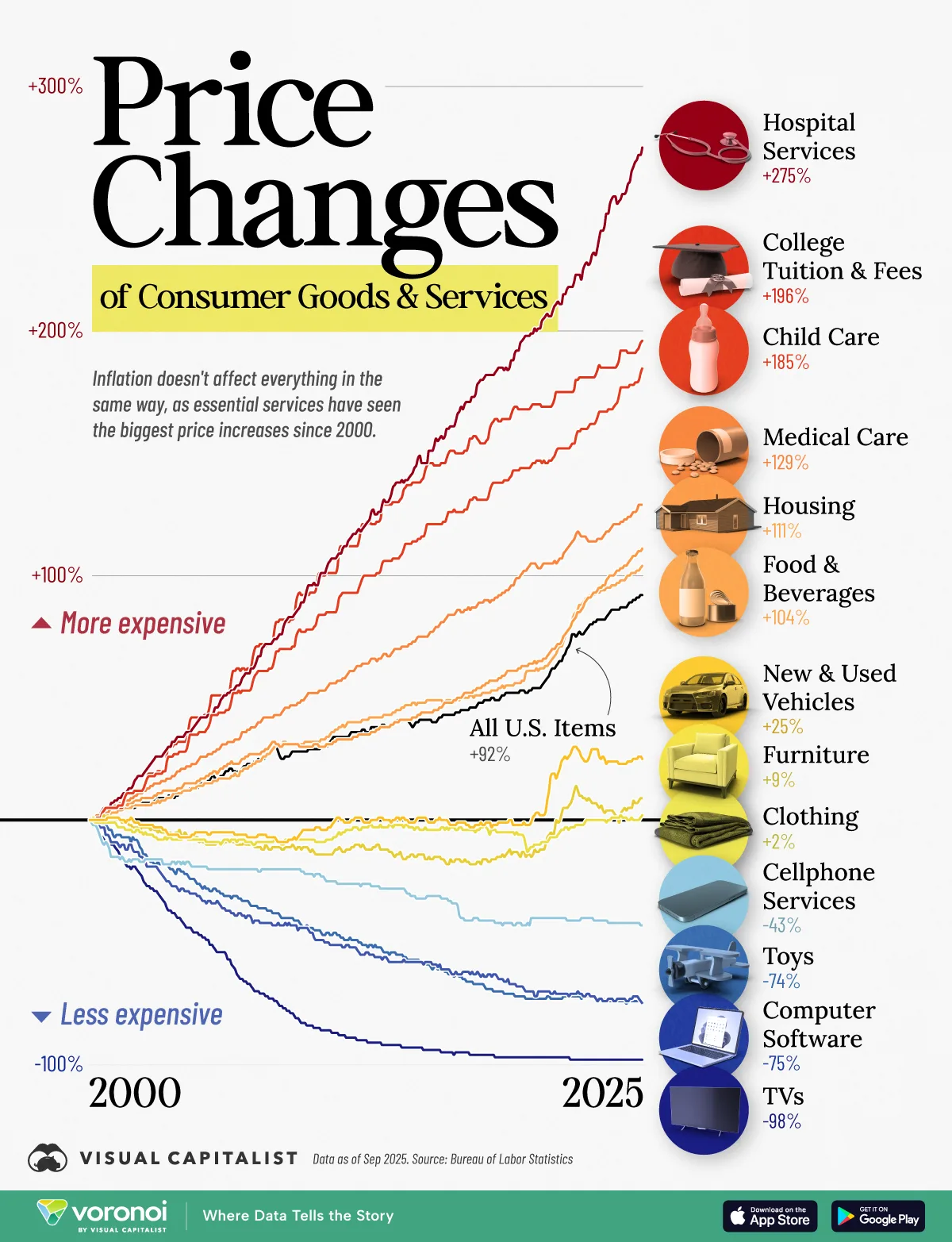
Which country is this for? No way this world wide. Wherever this is looks like a hell hole, geez. Necessities become more expensive while luxuries becoming less expensive.
BLS data, meaning it’s the US.
Yes, it is an actual hellscape.
Ah somehow missed the “US items” next to the lines.
I hate how US-centric Lemmy is. Why is the US all everyone can talk about on lemmy.world, a general purpose instance. There are country specific instances for a reason.
I’d say the US gets all the headlines because it’s the most influential country on Earth that is right now in an advanced state of collapse
TVs only cost 2% of what they did in 2000?
Ok. Did some digging and found:
BLS built hedonic models for goods and services in several areas including apparel, electronics, and housing for CPI and for computers and, more recently, broadband services for PPI.
So the “price” includes adjustments to imagine what a 50" flat panel might have cost of it had been possible back then. So a $200 dollar 50" flat TV that a single person can carry is extrapolated to be worth $10,000 back then, which at least in that case I can say sure. The minimum viable TV of 2000 no longer has anyone making that crappy, so you don’t see TVs under $10 new.
But it does mean that many of these rates might be “nicer” than presented.
Might only be comparing equal screen sizes, which would mean the better TVs of the 2000s are being compared to what are basically computer monitors today. And yeah, the cost of those now is negligible compared to an actual common mid-sized (let alone large) TV of today.
Even small tvs are not $6. Math is off.
But good luck finding any TV for 300 bucks in 2000. TVs were expensive back then.
Don’t worry everyone soon all the stuff below that line will be above it as well.
This graph makes sense when you consider the main cost of these goods/services. The ones that have raised in price are very labor dependent and human labor is expensive (as it should be). The ones that got cheaper are items whose manufacturing can include a lot of automation. What this graph shows is that human labor is expensive. That is obviously not the only factor, but I feel it is a good explanation for the trends shown.
Not just labor for the top categories, skilled labor. High costs for education then lead to skilled workers demanding higher salaries, further raising costs of those categories. If only society could somehow mitigate costs for education so there were more skilled laborers…