

Safety is at the heart of what we do
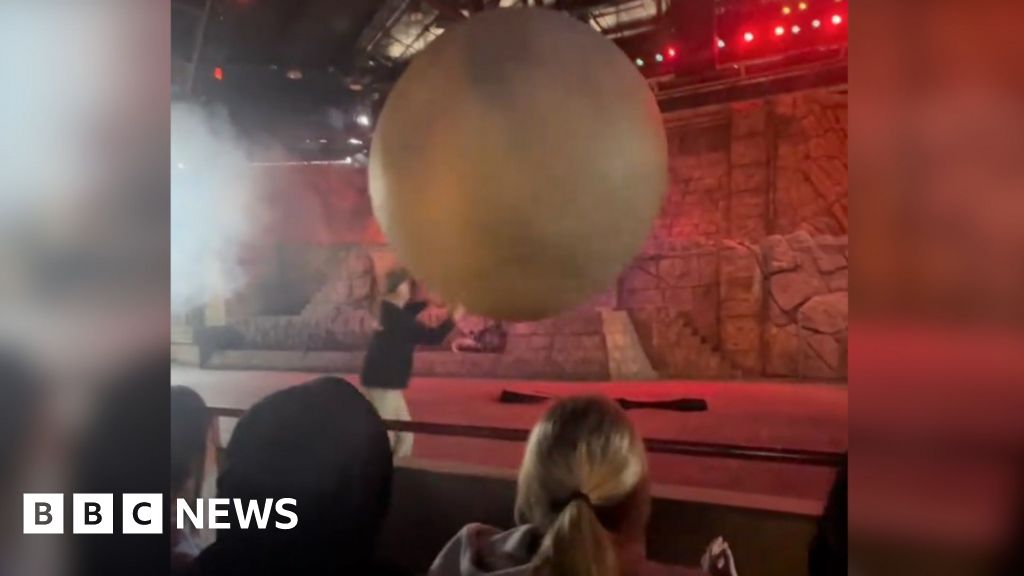
Except for the part of the show where the heavy boulder easily jumped its path and they had to have a human being stop it.
Exactly. Safety for the ride operators is just as important as audience safety, if not more so, for any carnival that claims to be safe and reliable.
It’s akin to a magic show. The whole idea is that someone is not supposed to get hurt. Penn & Teller have a whole trick where they talk about the importance of safety (the “magic bullet” trick).
Because you know what really ruins the magic? When someone gets hurt.
How much does that weigh in football fields?
American football, Canadian football, or fútbol?
Don’t. Get. Eliminated!

Right you are, Ken.
I can only think you lay down, it rolls over you, you get up and go again. Depends on what the rules are I guess. What are they?
I think the only rule is once you’ve started going, don’t get knocked back to the start. There may also be a time limit, I don’t remember. As for strategy, there are cutouts in the walls you’re supposed to try to slip into between boulders falling, but laying down is also totally valid.
With staff pushing you out once the boulder has passed! I don’t think this game had a time limit; it was more focused on “get to the top, if you can”. In MXC. I guess I have 0 context to the original game 😁
deleted by creator
How is 180kg “fake”???
deleted by creator
A real one would be like 10-100x that mass.
Hope dude gets a good payout
“He put himself in harm’s way.” He won’t get shit. Disney will also sue the person who filmed the copyrighted performance.
No, workers comp is exactly for this kind of thing. The deal is that workers get paid for injuries on the job regardless of fault in exchange for a simpler calculation of how much they get.
Before worker’s comp, it was very common for employers to claim the defenses of contributory negligence (the worker was doing something wrong), fellow servant doctrine (another worker was doing something wrong), or assumption of risk (cmon, he knew it was dangerous when he took the job). Those defenses are no longer available in workers comp cases, so payment is a bit more straightforward.
I would have expected a 400lb rubber bolder moving that fast to NOT stop when hitting an average sized person. Are they exaggerating the weight of the boulder?
Assuming a 200lb man and a perfectly elastic collision, the ball would be reduced to ⅓ its original velocity, while the man would be accelerated to 1⅓ of the ball’s original velocity, so 4× the end velocity of the ball.
There’s almost certainly some exchange between angular/linear momentum, but I’m approaching my wife’s tolerance for math at the breakfast table XD
Lol
It’s the second power rule, plus extra needed thickness for strength that makes it confusing. A ball that is 10x larger in diameter than a soccer ball is 100x heavier.
400 lbs vs 200 lbs means the 200 lbs person will be pushed with twice the speed if the ball stopped completely. Which is sort of what the video shows. mv=mv
Ah good point, I assumed the rubber deflection would have altered the interaction. But when a larger bolder hits something there has to be some impulse calculation, Like when a bus hits a cyclist, the bus doesn’t stop from firing the cyclist away fast
It’s a partially elastic collision. So basically all the momentum is transferred into the person. Makes the calculation really simple:
V_person = mass_ball / mass_person * V_ball
For the bus and cyclist it would be some small amount of momentum removed from the bus by the cyclist because the bus doesn’t stop. The relative masses are so different, which is why it appears the bus doesn’t slow at all. It does though, but only a tiny bit.
400 seems pretty high to me as well.
Disney listed it as 400 pounds which seems to be the source on this.
Dude held that camera more solid than than the boulder.
This is like the temu Ahmed al Ahmed.
Yeah 400lbs my ass that thing bounces like a big beach ball. You can even hear the rubber hitting the stage.
That struck me as way off base as well.
woof misjudged the weight there a bit
There is no reason for this prop boulder to weigh 400 pounds. Paper mache, hollow plastic or maybe fiberglass,
or inflatablewould have worked just fine.This is just a bad take. It literally is a hollow inflatable already.
I’m surprised they didn’t just design some magnetic roller system to couple the ball to the ramp and stop it if necessary. It really would have cost less than this person’s compensation, most likely.
A handful of small metal balls inside it and a magnet at its holding spot is all it would need id imagine
deleted by creator