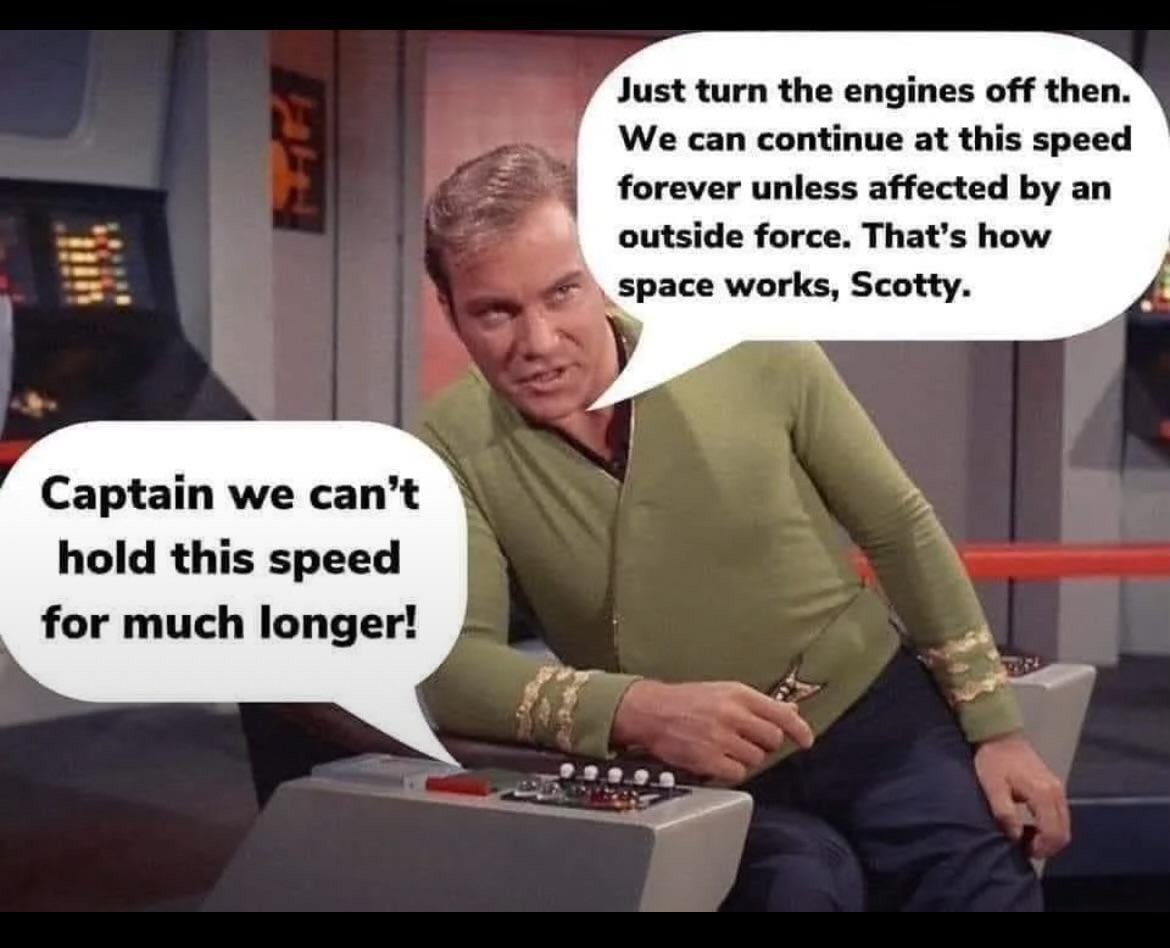

Love when sci-fi sneaks in a physics lesson 😂 In space, speed isn’t the issue—acceleration is.
At the speeds they travel literally everything is an external force on them
nah, thats movement relative to space time, warp suggests bending said space time in order to, relative to your destination, move faster than light, while essentially staying motionless in spacetime.
In this paradigm inertia is very much not a thing
This, the power is needed to maintain the subspace bubble, being thrown from said bubble from losing power has been shown to be dangerous. Maybe you just drop out of warp, maybe you drop out too close to something and have no control.
Thank you. I read this thinking “yeah this is not simple Newtonian motion”.
still funny tho!
Then explain inertial dampeners buddy! (No seriously, someone please explain to me why they need inertial dampeners at warp. It’s been bugging me for literally years.)
They also use “impulse”, which seems to be a very high powered inertial type deal. That should follow the rules we’re used to
Oh yeah absolutely. But I’m almost certain I’ve heard them complain about the intertial dampeners being maxed out or something when they’ve been flung to crazy warp factors by one of the various near-omnipotent aliens they seem to encounter at least once a season lol.
They’re inside a bubble of newtonion rules while doing crazy things to the space around them. If something jostles them hard enough, the whole crew would stop being biology and become physics. Inertial dampers stop that.
I don’t even care about the meme anymore, the number of people in here that are confusing bending with warping is driving me crazy! Watch some cute animated ducks and a british guy explain bending.
edit: i forgot about einstein-rosen bridges, those ARE described as a wormhole that is created by warping spacetime, but this isn’t how the warp engines in the show supposedly work.
double edit: tried to post a cute short video but it doesn’t cover warp so here’s a significantly more technical series of videos covering warp drive.
the number of people confusing warp with wormholes is luckily not that high, to my knowledge you are the only one here 😂
I saw at least 6 people describe star trek warp engines as “folding” space before I posted! The warp engines in star trek don’t fold spacetime like a wormhole, they contract spacetime in front of the ship and expand it behind the ship. You know, warping it! I’m having trouble getting images to upload with the migration but here.
ok, but why did you link to Wormholes Explained?
Because I couldn’t find anything that explains both folding and warping in a cute 8 minute video, so I posted the one that at least explains folding, figuring people on a Star Trek forum will be smart enough to infer the difference. Here’s a nearly 2 hour “intro to black holes” video as well as a collection of videos talking about warp drives if you’re interested.
yeah, i am “smart enough” to infer the difference, otherwise i couldn’t ask “why are you showing video that explains the wrong answer to the question discussed”. that is heavily counterintuitive 🤷♂️
I don’t mean for that to come off as rude, I was including you in the intelligent comment! Anyway, it was mostly a silly post in a silly thread about silly science fiction and this is turning into not silly fun anymore so I’ma peace out!
I don’t mean for that to come off as rude
i couldn’t care less about if someone on the internet calls me dumb, i was just really confused, because you seemed to be arguing the right way and then linked to the wormholes video. peace 🖖
ITT: Angry Trekkies.
I mean yeah, that’s not how Warp works! Impulse sure but not Warp
In the Trek universe ships do not accelerate at anywhere near relativistic speeds, they create a “warp bubble” that compresses space behind the ship and expands the space in front of the ship, creating a kind of pressure differential/wave (as in ocean waves) in spacetime itself. The ship doesn’t “move” at all at warp. To quote the late, great Cubert Farnsworth: “I understand how the engines work now! It came to me in a dream. The engines don’t move the ship at all. The ship stays where it is and the engines move the universe around it!”
That said, I don’t think I’d want to be moving at any speed through space without a way to slow myself down.
Canonically the impulse engines at least on the Enterprise D can achieve a top speed of 0.25 c. This means that when they’re being “cautious” and moving at one quarter impulse, they’re still moving at an insanely high velocity.
Was talkin about that in another comment thread actually. My headcannon is that’s why you hardly ever see them use full impulse unless it’s a life or death situation. Like you said, even 1/4 impulse is still something like 20 million meters per second.
Edit: If anyone is curious, the fastest man-made object in the universe is currently the Parker Solar Probe, which hit 0.000641C by slingshotting around Venus seven times!
What if we blow a tyre captain?
You just turn off the flat tire simulation program, duh!
Not quite. The warp drive doesn’t actually provide any thrust, its purpose is to create the warp bubble and then “squish” the space in front of the starship.
Thus the “warp engines” do actually need to get constantly fed energy in order to work. Feed more energy equals get more squish equals go faster.
It doesn’t the ship through the universe, but the universe around it!
To suspend disbelief, when any non-hard sci-fi show says “speed” I subconsciously translate it to “acceleration.” If the ship they’re chasing (or being chased by) is pushing their engines to the max then the enterprise also needs to push its engines to the max to match the speed. If they just free-float at constant velocity then they’ll fall behind very quickly.
This. The writers just dumb it down a bit for the normies.
I don’t even think it’s dumbing down. Speed is relative. That’s just how you’d say it when you’re describing your acceleration relative to another body, spaceship, whatever. No one thinks or cares about your absolute velocity on a universal scale.
For the same reason we describe speed relative to the ground on earth. Nobody’s specifying that we’re traveling ~1,624km/hr west, and ~1724km/hr east, they’re just going 50km/hr
The Expanse had some great dramatic moments caused by this important distinction. Like, they only had gravity if they were constantly accelerating. The moment you stop, no matter what speed you’re at, relativity will get rid of the “gravity” effect. So if you wanted to, say, perform surgery in zero-g then you’d need to be constantly accelerating to higher and higher velocities for the duration of the surgery.
Yeah, at impulse they would still want the deflector shields, but at warp they can only remain faster than light due to power creating the warp bubble/field. Like a rubber band, you need to constantly exert force to repell the elastic forces.
So what you’re saying is, we need more rubber bands

Good God, you’ve finally unlocked warp factor 10!
Let the salamander sex party commence!
All that technology but no idea how to use it, they truly are a primitive race.
There’s never a time when you don’t.
Like a rubber band
A true Trekkie
To argue in the spirit of OP’s meme:
You can’t create warp bubble/field as you go faster than light. Under relativity (to say nothing about other physical theories) “faster than light” travel is possible only if the “warp field”/“bent spcetime”/“wormhole”/etc. is already there and you’re just using it to travel.
Faster warp is probally akin to “better bubble/space time folding.” Cant maintain this warp speed is akin to saying “we dont have the power right now to maintain this complex of a space time fold.”
My point is you can’t be the one making the “fold” that you’re traveling in, no matter how much energy or whatever you have. If you do that your travel would either be slower than light or it would severely violate relativity (in ways that Alcubierre drive or wormhole or whatever don’t).
An alcubierre drive is literally folding space around the ship, ST warp drives are more or less a primitive version of the concept. And do currently have an issue (as much as a theoretical technology can have issues) that we don’t actually know how you would accelerate such a bubble of folded space.
The answer is you don’t. You (the person on the ship) can’t do it. That would be incompatible with relativity. Someone else has to set up the bubble for you beforehand. Alcubierre warp works more like a highway than a magical engine.
You all are mixing your metaphors a bit. Wormholes “fold” space; imagine if the universe was a piece of paper. Now fold the paper in half and poke a pencil through it. That’s folding. “Warp” engines, like the Alcubierre Drive, do just what they say - they warp spacetime itself around the ship by compressing the spacetime behind the ship and expanding the spacetime in front of the ship, essentially creating a pressure differential that naturally pulls the ship along it’s new modified world line. This is what they’re talking about any time you hear them mention a “warp bubble”.
deleted by creator
Futurama may have gotten this “correct” in that the ship doesnt move in warp as much as it lets the universe move past it. The warping ships are held outside of spacetime, and “move” based on the shape of the bubble.
Maybe higher warp is just a more complex bubble that makes the ship more abstracted from spacetime.
That doesn’t fix anything. Physics doesn’t care if you’re the one moving or if you declare yourself to be still and the rest of the universe is moving.
“Held outside spacetime” also makes no sense at all in the context of relativity, but if they want that to be their sci-fi sauce then that’s fine.
I dont know why youre so set about fitting Star treks science into the framework of ours science. They either are insanely past our limited understanding of physics, or its absolute bullshit and cant be slotted together.
We see in TNG alone that warp bubbles exist and are generated by onboard ship components. We seem them move great distances inside them, and know they require intense power to maintain. It clearly works because we see it work.
But besides that, TNG has lots of other impossible “move fast” options. We know that there ways of travel that far exceed warp speed powered by “thoughts,” and not just one “thought” based hyperspeed either. You have the “traveler sparkly warp” and the “barkley think good” wavy warp, hell you even have gumtoos “spinny warp” that tossed the enterpise and romulan ship way past their top speeds.
Dont get me started on Q or tom paris hitting warp 10 to go “everywhere all at once.”
Pretty sure the warp drives need continuous power to contract space in front of the ship and expand it behind the ship to allow faster than light travel
The ship isn’t actually moving during faster than light travel, it just bends space around it
They can only move at impulse speed without engine output due to their being no friction and gravity in space
Even when the impulse drives are down, the ship always just stops 🤷♂️
My favorite bit is how when life support goes offline, it’s like they’re running out of oxygen within seconds. I once saw the math referencing the actual canon dimensions of the Enterprise D and its canon crew complement. It’s comically large for the number of people in it. You could shut off all the CO2 scrubbers in a space that cavernous, and it would be months before the crew began noticing any ill effects. The Enterprises are god-damn ginormous.
The Enterprises are god-damn ginormous.
It’s all those bowling alleys and home theatres they installed in the lower decks.
I recently saw a DS9 episode where O’Brien said life support is down and it’s going to be a problem in a day or sth, was pleasantly surprised at that.
Might still not be accurate, but at least it was not a “oh shit we’ll die now” kind of thing.
It depends. Lack of air circulation can cause problems in minutes as people can end up breathing stagnant air. Less of a problem if you have artificial gravity as then you have convection and/or the coriolis effect to help keep the air moving. As for actually running out: less of an issue.
It’s the Vulcans. They actually respirate at 1000x the rate of humans. It’s how they remain emotionless. They are too focused on breathing to get angry. The massive compression necessary to breathe that much is actually how they are constantly so full of hot air. They don’t actually need to breathe that much to survive, but they are just too proud to give it up even in an emergency situation. It’s all a weird power play. 🖖
Did you steal this from Dr mccoy’s Facebook?
Oh I’m sorry, is a ship’s head medical officer with decades of experience treating a dozen or more species of crewmen and guests not a good enough source for you? Don’t let those pointy eared bastards fool you. They’re devious.
For one time in their cold-hearted miserable lives couldn’t they just give a damn?
Ok season 1 archer
I think they might actually be in fluidic space and just really unobservant.
“It’s like flying through soup, sir!”
“Mmm… Soup… 🤤”
split pea, clam chowder, or bean with bacon? this commodore’s hungry
I mean, technically all space is fluidic space. The interstellar Medium is a fluid. It transfers pressure waves, has a temperature, has a density, even a viscosity.
https://en.wikipedia.org/wiki/Interstellar_medium
Normally you can ignore the drag from the Interplanetary or Interstellar media, but if you had a ship that could travel at high relativistic speed, pushing past 0.9c, 0.99c, 0.999c, etc., you actually would have to consider the drag from it. Ships going that fast would have to be designed with aerodynamic principles in mind, just like atmospheric craft.
Normally you can ignore the drag from the Interplanetary or Interstellar media, but if you had a ship that could travel at high relativistic speed, pushing past 0.9c, 0.99c, 0.999c, etc., you actually would have to consider the drag from it. Ships going that fast would have to be designed with aerodynamic principles in mind, just like atmospheric craft.
This is new and surprising to me. Do you have a source? It seems to me that if it gets to a point where you need to design your ship using aerodynamic principle, you should also be able to drive your ship using aerodynamic principle (i.e., push on stuff around the ship, instead of expelling propellant from the ship as usual spacecrafts do).
I suppose if you could develop some type of sci-fi magnet ram-air funnel thingy you could make something work with the hydrogen atoms drifting around, but you’d still have to jet something out the back to keep going. Less like a rocket, more like an airplane.
Like the ships (lighthughers) in Revelation Space and other works from Alastair Reynolds :D
Except when they go into orbit and then things work as expected.
There is definitely gravity in space! It just doesn’t feel that way because there’s no ground so you’re mostly in free fall which to you is indistinguishable from being in no gravity. (fun fact: this indistinguishability is actually the crux of General Relativity!)
Yep, everything is in freefall orbit of something bigger.
What if you are in the gravity center of the universe?
i think that would actually be the case most of the time.
you don’t care about anything outside the observable universe and inside that bubble, the cosmological principal would apply, stating that on a large enough scale, the universe and distribution of matter in it is considered homogeneous
so unless you are in close proximity to some local gravitational source, i think you would be generally affected by roughly the same gravity from all directions.
we are not doing the math for your mom
Let me know if you ever go.
It depends. Impulse engine? Sure. Warp? Nope. Also, you need shielding.
What about hyperdrive?
For the curious, OA has a pretty extensive, physically plausible theoretical writeups on warp bubbles:
https://www.orionsarm.com/eg-article/493f29cc472f0
They’re the STL kind, but still, they do seem to require power.
AFIAIK the impulse drives are sub relativistic in Star Trek, right? Or maybe they aren’t, but that seems.
they just throwin redshirts out the back thats why impulse drives are red
There’s a writeup from a few years ago by a NASA scientist talking about the Alcubierre drive if you want something that’s closer to Star Trek engines. Although spoiler alert, they conceded that a ship would already need to be moving at SOME sub-luminal speed towards the destination first in order to control direction. Can’t just fire up ye olde warp engines from a standstill like they do in the show, apparently.
https://ntrs.nasa.gov/api/citations/20110015936/downloads/20110015936.pdf
Alcubierre drive
Exactly! This is what OA is using, albiet a modified version that doesn’t violate causality like the original Albecurie. See the original link and: https://www.orionsarm.com/xcms.php?r=oa-faq&topic=FTL+in+OA
Star Trek engines are something between displacement and halo drives, though with the bubble technically being “internal” and the ship following all relatavistic limitations:
A warp bubble is a region of space time enclosed in a fold, or bubble, of highly curved space. By expanding the space time metric behind the bubble and contracting the metric in front, the bubble can be made to move without the use of propellant mass. The vessel can apparently be coupled to the warp bubble(s) in various ways; by containing the bubbles wholly within the ship, as in the Displacement Drive; in front of the ship, coupled by gravity and/or magnetism, as in the Halo Drive; or entirely enclosing the ship, as in the Void Drive.
Note that no warp bubble has ever been observed traveling at super-luminal speeds. It is thought that such faster-than-light travel is impossible with void bubbles, because of dynamical instability of the warp metric at speeds greater than light and a suspected high flux of Hawking radiation that would turn anything inside a faster-than-light void bubble into a plasma of fundamental particles.
In the Displacement drive configuration, void bubble based drive nodes, operating in either the Alcubierre or Natario configuration, are enclosed within one or more magnetic containment vessels aboard the ship. The drive nodes are magnetically linked to the vessel within the containment volumes and react against it as they move, effectively pushing or pulling the ship across space with no ejection of reaction mass.
Only wormholes are “FTL,” with the catch that they have to be created and transported very carefully with respect to their light horizons (lest a configuration creates closed timelike curves and makes them explode)
Okay cool, I didn’t put that together while reading the first post. Although my understanding is that Trek warp drives would fall into the Void Drive category based on these descriptions. The bubble completely encases the ship while at warp and effectively shortens the world line they’re following, at least from the ship’s perspective. In the famous “Neelix almost kills the ship with cheese episode” they create a “static” warp bubble and invert it towards the ship in order to heat up all of the biogel packs on Voyager. Also I looked up the impulse engine thing and they arent relativistic but they are capable of accelerating a ship to 1/4C which is surely enough to cause some time dilation issues.
The void drives in OA are a bit crazy in that they’re almost like little pocket dimensions: sub microscopic, maneuverable, “bigger on the inside” like a Tardis, and requiring further nested void bubbles to enter/exit them without destabilizing. They’re more like something Q would use in their civil war. The description may sound closest to ST’s “ship inside warp bubbles,” but mechanically the displacment/halo drives are closer and their attempt at “more physically consistent” ST warp drives, while void ships are at the absolute edge of what’s possibly plausible in physics, assuming all engineering issues go away.
A giant ship at 1/4c is still quite high, yes… it’s also at the point where, under normal physics, you’d have to worry about things like the exhaust plume vaporizing whatever’s behind it.
Also Q help you if the navigational deflectors wink out for even a microsecond lol. I’m not a physicist but I’m fairly certain that hitting a mote of dust at 1/4C would cause a large enough explosion to wipe out an entire planet, if not an entire solar system.
A 1 gram rock would be “almost nuclear,” yeah, but not planet killing, and most micrometeoroids/cosmic dust is fortunately much smaller than that.
I found a fun calculator trying to research this. An object weighing 1 microgram, travelling at 0.25c, would contain nearly 3 megajoules of kinetic energy. So yeah I guess dust wouldn’t be apocalyptic but that still wouldn’t be fun to bounce into/through.
They’re specifically soft when it comes using impulse vs warp for both subliminal and superliminal speeds. It’s whatever the writers needed at the time. It makes sense that they can use warp to go almost any speed, but it’s a whole lot of power to warp space just to cruise around a solar system. I think there was at least one episode of TNG where they went light speed or close to it with impulse, but I may be misremembering, I just remember thinking that’s not how their own science works.
ST doesn’t seem to respect relatively anyway, so I guess it doesn’t matter, heh. The physics are different.
They do and they don’t, again, depends on the writer, but relativity is a really hard concept for the average show watcher. Sci-fi doesn’t really exist without relativistic breaking tech of some sort. ST has warp and subspace communication. They have reasons those break relativity, and they kind of stick to them. Then they have beings like the Q that might as well be gods. And sometimes actual gods in TOS. As a whole, the series is nonsense. But they try to make it less so over time and that just makes it retconned nonsense.
For example, impulse engines can not accelerate a ship to anywhere near the speed of light. But they can accelerate it to enough of a fraction of C that things like time dilation become problematic. No breaking of physics but surprise surprise now your crew is 3 minutes younger than they should be, relative to Earth. Add that up over time and you’d potentially have to start swapping out crew members so that they don’t end up younger than their children when they retire. The Star Trek Voyager Technical Manual lists “full impulse” as 1/4C, or nearly 75,000 kilometers per second, which is probably why you hardly ever see it in use unless it’s a life or death situation.
It’s a different kind of space. They’re going faster than light.
In every ST series, they only ever say that in warp. And nobody has no idea how warp works.
I just know if you go faster than Warp 9 you’re fucked
Warp 10. The Enterprise C regularly surpassed 9.5.
The D. We only saw The C once. That was the ship Tasha went to with Shooter McGavin.
IIRC the in universe reason for the E’s long ass nacelles was to allow it to achieve 9.95. I am pretty sure I remember part of the expanded universe going into experimental refits of the USS Sovereign that allowed it to hit 9.995.
Didn’t rikers enterprise go to warp 13?
Rikers enterprise went to Warp 69
It did, but it also attacked the klingons from below rather than the standard head on so we know they writers were all high when they wrote that!
Writers are not physicists, and the TOS Enterprise also had a few minutes above warp 10 at some point. It’s whatever a set of 2-4 writers and 3-5 producers decided that week, and retconning the awkward bits later.
It’s whatever a set of 2-4 writers and 3-5 producers decided that week, and retconning the awkward bits later.
it is actually not, they had detailed manual for that. star trek was inconsistent or vague about lot of stuff (for example how their economic utopia works), but they usually tried to have their technobabble consistent.
they changed how the warp speed works between TOS and TNG.
https://memory-alpha.fandom.com/wiki/Warp_factor#Star_Trek:_The_Original_Series
(not saying there weren’t exceptions, for example there were some really random numbers flying in the equinox double episode.)
Then tell me what Tom Paris did in the Cochrane shuttlecraft ;)
That’s my point. It’s a standard until it’s not for a convenient plot reason.
TOS:
Warp factor 	speed (c) 	travelled in 24 hours (ly) 	Earth to Alpha Centauri

9 	729 	1.996 	52.07 hours
10 	1000 	2.738 	37.96 hours
11 	1331 	3.644 	28.52 hours
from TNG forward:
9 	1516 	4.15 	25.03 hours
10 	∞ 	∞ 	0
the lizard babies episode, however absurd, is in line with this.
I never was making that claim, just that the person I replied to say going above 10 was dangerous
At some point in the cannon they decided warp 10 is the transwarp limit. They ignored it a couple of times.
they changed that between TOS and TNG.
https://memory-alpha.fandom.com/wiki/Warp_factor#Star_Trek:_The_Original_Series
Sure, but I’m saying that any thought or concern about a canon transwarp limit is at risk of being dashed by the whims of people looking for a plot device.
Oh for sure, warp factors and the limits thereof can be bent to fit a particular story
Well, at minimum, fucking seems to be involved.
The Delta Flyer went above Warp 10.
But that was Voyager, and Voyager frequently is not considered cannon.
Yeah, but you get to have sex with the captain, uncaffeinated.
Warp 10 was how they got back, wasn’t it?
But it’s also at the end of the Star Trek timeline, so they’re allowed to advance the tech curve a little bit
Warp 10 was how they got back, wasn’t it?
no, warp 10 is how paris and janeway made their lizard babies, left them stranded somewhere and then never talked about them again. worf is parent of the year compared to these two.
Voyager took a Borg transwarp corridor to get back to Earth. Future Admiral Janeway facilitated it.
But for some reason they keep dropping out of orbit around planets.
What else were they orbiting?
Stars, crystaline entities,…
Lady streamers at twitchcon
I can only remember occasions where they had atmospheric drag, dropping out of orbit is much more of a Star Wars thing.
But I can believe one of the new shows fucked the entire thing up.
less so in nutrek, old trek usually has some techno-babble included. i wonder if they think the viewers will get bored to death from a pseudo-explanation of how warp works, eventhough they sorta explained it over the franchise as (contracting and expanding space using a subspace field).
transwarp, vortex, slipstream kinda sidesteps the speed of light in our own universe, by interdimensional travel, hence why its faster than warp.
Unrelated but in the expanse they really nailed those aspects. When there’s a pursuit, it’s always an acceleration pursuit, which is limited by how much G the characters can tolerate, and for how long.
The only magic tech they introduce is a super efficient fusion core engine, but they use it to improve realism rather than destroy it. It’s great.
And they accelerate through the first 50% of a journey, flip, and decelerate the remaining 50%. I can’t name another sci-fi tackle space journeys in a realistic way like that. Everything else just treats it like air travel - pushing your way through something with drag.
My favorite touch is how the rooms are stacked vertically in the ships so the gravity is provided by the acceleration. Also how pouring drinks always happens differently depending on the gravity and spin off the body they’re on. Man I love this show!
Man I love this show!
WHERE SEASON 7? 😭
I think the rest of the books happens after a hiatus of a thousand years, doesn’t it ? I doubt it’s even the same cast of characters, not sure i’m interested in that.
There are nine books and they all (give or take a few) follow the same main cast. Extremely minor time-skips excluding the following. Spoilers:
Tap for spoiler
There aren’t any time skips besides for minor ones, except at the end of the series, after the destruction of the ring network and the death of holden, where there is a massive time-skip to the point one of the ring colonies develops sufficiently advanced interstellar travel, to the point they are able to visit earth and be greeted by the now-immortal Amos.
Jesus Christ that sounds awesome. I have to confess i haven’t read the books, just seen the show. But immortal Amos feels like something i should know about ! I’ve downloaded the audiobooks recently and will probably be listening to that but that’s likely to take a long time to go through.
When I saw the engines in front of the ships… I got so confused lol… like: wtf, why is it moving forward when the engines should be pushing it backwards? I had to google it and then I was like: aaaahhhhhh that makes so much sense now
Alastair Reynolds is good about this in his work.
Yep. Did it way before the expanse. I think that was my first introduction to the concept of accelerate flip accelerate the other way.
I would like to see more settings with beam-powered propulsion. That’s honestly the most realistic way of actually achieving interstellar travel. You set up large beaming arrays powered by fusion reactors or huge solar arrays. Or you build a laser system right out of the Sun’s upper atmosphere. Then you accelerate to significant fractions of c, riding on a beam of laser light.
Slowing down is a problem, but even that can be done with beam power. As it approaches a destination system, a ship can unfurl a secondary mirror array. If the system back at Sol can maintain focus over that distance, you use the secondary array to bounce light back onto the incoming craft, slowing it down. And if you can’t maintain focus over that distance, you can use chained pushing lasers powered by the destination Sun to send a slow down array ahead of your incoming crewed starship. Then you just have pushing lasers installed in both systems, and you can easily send ships back and forth.
If we end up ever actually doing interstellar travel for real, it’s likely to be through this method. Laser light sails are the cheat code for practical interstellar travel, but they almost never show up in fiction. Which is a shame, as there’s a lot of interesting settings and themes that could be explored. If you’re riding on a beam ship, you don’t actually have engines onboard capable of speeding up or braking your ship. You surely have some engines - to avoid space debris and for navigating before/after being accelerated/decelerated by the laser arrays. But you are ultimately completely at the mercy of the people operating those beaming arrays. If you’re relying on a braking array to slow your ship down at its destination, what happens if the destination system decides you’re no longer welcome there? By simply not turning on the laser, you will be doomed to scream off into the void. And speeding up/slowing down is just such an intricate dance of light and momentum. Lasers have to be aimed at not where your ship is, but where it’s going to be. And a chain of many stations may need to work together, each in their turn, for the journey to succeed. And who is paying for all this infrastructure? Who controls it? Is it nation states, unified world government, is it private corporations? Is travel on them free, or do you have to pay a lifetimes of wages to afford a ride on a beam ship? Lots of possibilities. Oh, and since ships travel along known paths, space piracy is a real possibility in the right setting.
Not to mention a beam that powerful is naturally a highly potent weapon with potentially interstellar ranges, that’s a lot of power even for a government.
This is how they do interstellar travel in James Cameron’s Avatar
The Mote in God’s Eye covers this light sail.
It starts with humans detecting coherent light (a laser) and realizing it’s propelling a light sail. It loops around the sun and now heading the opposite way the light impulse is now decelerating.
The Heechee series by Fred Pohl uses a reasonable system, including relativity. A major plot point is that you can get into one of their magic ships, press the button, and pray your food halfway point holds out until the ship flips to brake.
I’m on the second Expanse book and I am fucking loving it. I absolutely love hard Sci-Fi. I think The Expanse is taking the cake for my favorite Sci-Fi book series. Before this is was The Three Body Problem series. I specifically love Death’s End
Haven’t gotten around to the 3 body problem yet, but it seems reaaaaally nice !
It’s an amazing series. I highly recommend it. I like the third one the best.
Well, and the acceleration drugs they take to withstand the high G. Kinda unobtainium drugs.
Shit you’re right that’s also magic tech