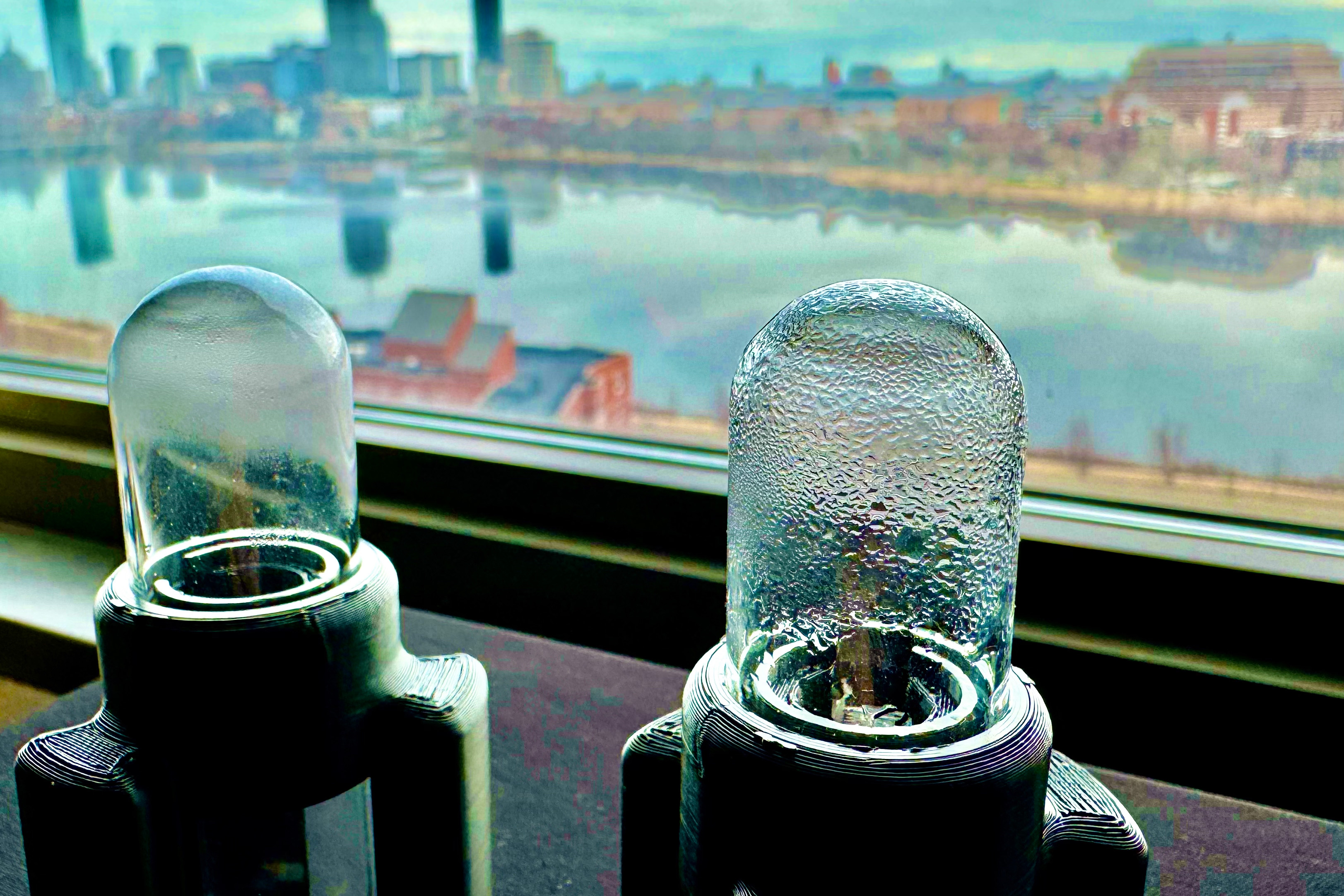
I’m curious, do ultrasonics also fatigue the capture material, shortening its lifespan?
It’s possible, but not as much risk as other factors. I would expect the sorbent needs to be replaced mostly due to atmospheric exposure than the sonication. Sonication could accelerate environmental degradation. This conclusion would vary by the sorbent used.
Risk 1: degradation of the sorbent supramolecular structure.
The paper uses a hydrogel made from polyacrylamide and lithium chloride (PAM-LiCl) that is placed on top of a sonicator and typically treated <10 min at a time. I’m not familiar with PAM-LiCl hydrogels specifically, but many polymeric hydrogels have self-healing properties for the super molecular structures that could reform after disruption by something like sonication or shear-stress. This is addressed in the supplementary info of the paper and the conclusions sections say they didn’t see the structure break down from the treatment based on SEM images. I did not look at this figure to double check that statement.
Risk 2: degradation of the polymer/molecular structure.
PAM is relatively resistant to the mechanical and temperature stresses it would be exposed to under these conditions, so I expect little risk from the sonication treatment. To assess that, we should consider the nature of that treatment.
They designed their sonicators themselves, so I can’t directly compare them to what I’m familiar with using, but the frequency they use is relatively high (>100 KHz) with relatively low power (1.5 W) compared to the types of sonicators used to break apart nanomaterials and the energy from the treatment does not appear to be focused, meaning the energy transfer is spread throughout the material relatively well. At higher frequencies, sonication treatment is not particularly well suited to breaking apart materials. You would want closer to 40 KHz to effectively break apart materials in the microparticle to nanoparticle range (typical size range for hydrogel supramolecular structures). The power used here is also relatively low and unfocused, so even if the frequency was lower, it wouldn’t have much power to break apart the sorbent material a d the energy is well distributed. Any focal points created could experience higher rates of degradation if they exist within the material.
If the treatment is not risky, then the main risk for PAM degradation is exposure to the atmospheric environment. This would be necessary for water extraction, but could expose PAM to conditions where it would begin to degrade or become contaminated and lower the water extraction efficiency. Acidic or alkaline conditions, exposure to oxidizers, free radicals, etc. would be the main contributors to degradation. Exposure to all of these would increase with time exposed to the atmosphere (and oxygen).
Conclusion:
My guess is that the sorbent would eventually need to be replaced, but even if the sonication doesn’t contribute to this, exposure to the atmosphere will be a big factor in contamination/degradation of the sorbent material. What sonication treatment would likely do is contribute to speeding this degradation up. I could also see something surprising happening like the sonication process protecting the material by helping clear contaminants that lead to faster degradation via “washing” with the water pulled from air too, so maybe it could even be beneficial.
The authors discussed applying this to other sorbents, so my answer would change with different materials, but where it would be viable to apply this technology, you could engineer the sonication to be minimally fatiguing to the sorbent.
Sources:
-
The nature paper didn’t want to load for me, so I used arxiv for the paper High-efficiency atmospheric water harvesting enabled by ultrasonic extraction)
-
Polyacrylamide degradation and its implications in environmental systems
-
Some additional resources for dew harvesting:
https://www.opur.cloud/ - International Organizations for Dew Utilization
https://www.rexresearch.com/dewharvest/dewharvest.html
https://iwaponline.com/ws/article/22/1/697/83295/Analysis-of-different-condensing-surfaces-for-dew
From the first paragraph of the article:
Even in desert conditions, there exists some level of humidity that, with the right material, can be soaked up and squeezed out to produce clean drinking water.
In the dry dessert the amount if water in the air is so minuscule that it just doesn’t doesn’t make any sense to do this.
Regarding the “clean” claim, you would get all the crap from the air in your water, also to preserve the water you would need to keep it chilled after boiling it, else you get sick, badly sick.
Harvesting water from air the most pointless thing to put money into. The only places with enough water in the air to make it worth it already have plenty of water. This is always snake oil.
My dehumidifier hates you, you mould shill
Yes, this is 100% accurate!
To the downvoters, please don’t just downvote, give me a plausible scenario of when harvesting water from air is more useful than just cleaning existing water.
Condensating water is VERY energy intensive, filtering far less so.
It’s not the condensing that takes energy, it’s the thermal release of the water from the desiccant that takes energy. Here’s the real paper with all the details. Avoiding thermal release in favor of mechanical release of water from the desiccant bypasses a good portion of the energy required.
Cool, but the fact remains that you can’t get a useful amount to water from dry air, and in a humid climate there are other sources of water that is cheaper and easier to exploit.
EDIT: downvoting facts I see, please don’t turn Lemmy into Reddit
People just want it to be true. They’re willing to buy into the scam.
Yeah, I remember watching Thunderf00t’s videos on Fontus and the other stupid shit
I would not put any stock in anything Thunderfoot claims, he’s a grifter and makes profoundly dumb arguments.
Source is biased obviously, but contains many, many references: https://skepchick.org/2025/01/thunderf00t-is-still-an-ignorant-loser/
Remember that a person can be a dick and still be correct.
I did find his rant about feminism to be annoying and over the top, but when it comes to science, like it or not, he has plenty of credentials.
But since you dismiss him so easily, please tell me what he is wrong about with regards to water from air tech.
Nah, he was right then and is still right. The anti feminism thing was a weird tangent that a lot of the skeptic channels did go down for a while. Then a lot of them continued down that road and became alt right. Thunderf00t did not.

“Energy intensive”.
There are also commercial versions that are designed for permanent use. Again, zero energy use.
Generally when you make a claim, its on you to back it up with evidence, not everyone else to ‘prove you wrong’. “God is real, prove me wrong.”
https://www.futurity.org/water-harvesting-condenser-humidity-2588972-2/
That isn’t some ultrasonic bullshit, that just uses passive solar and humidity.
Yes, correct. User was claiming “water condensation” is energy intensive - not just the particular tech in the post.
I pointed out how silly of a claim that was.
That works great when there is moisture in the air, whwn there is moisture in the air, there is usually a better way of collecting it for less energy.
You posted a solar still, a device which uses solar energy to distil water, an excellent solution to get water while on a desert island.
It won’t nearly as well in dry climates
Also, “zero energy use”?
Are you high?
Sunlight is still energy, it absolutely uses energy.
Finally, the is a new adaption of an old tech that has been proven to not work as advertised time and time again, it is on the creators of the new tech to prove that it works, I don’t have to disprove this at all, that has been done time and time again.
Haha claiming the sun is “energy intensive” is some new mental gymnastics that I’d not heard before.
Will ignore you now 👍
There’s some places where fog nets are viable. Here’s a video: https://www.youtube.com/watch?v=Pw5mtky8rF8