

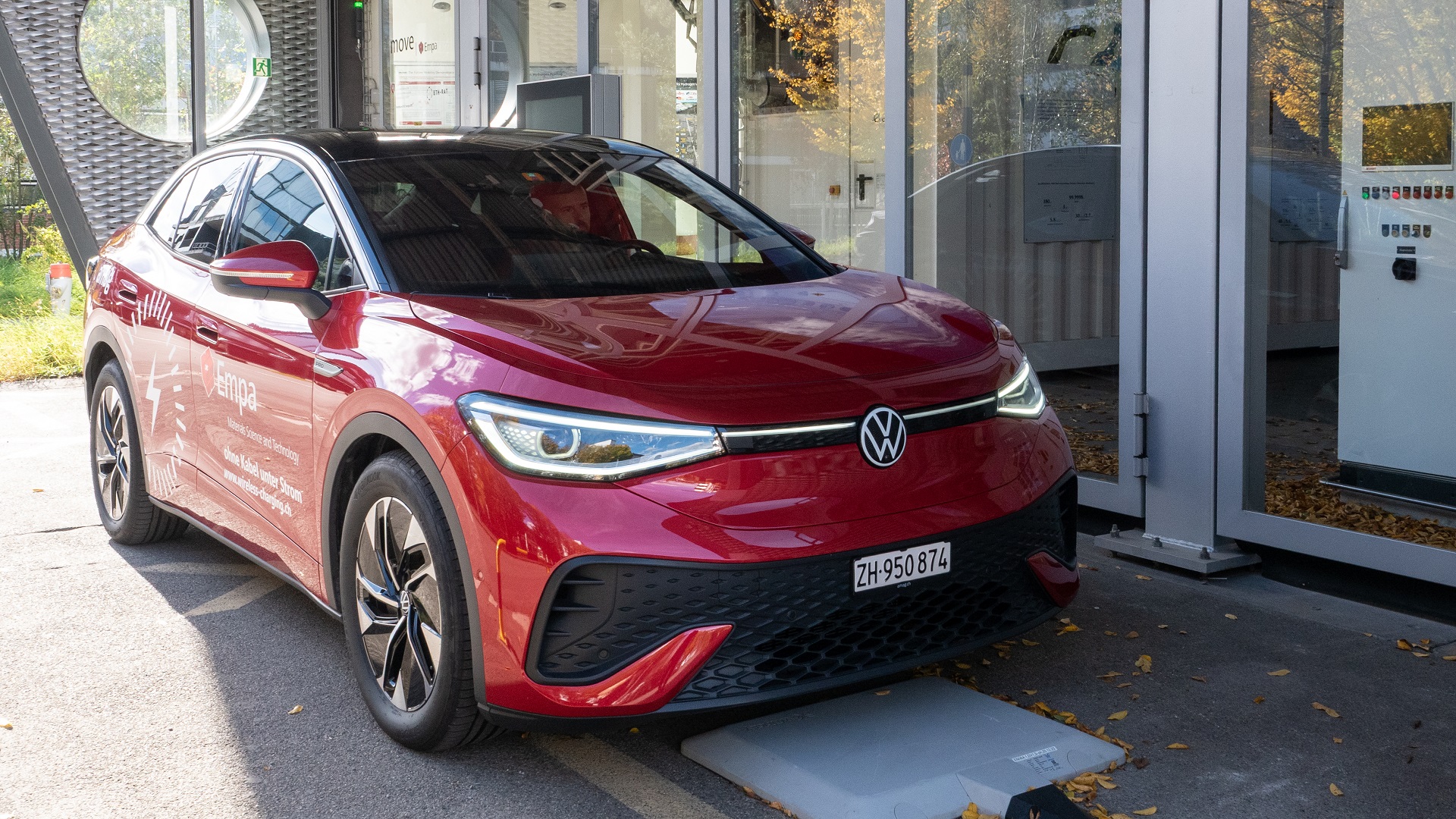
Bonus video of Swiss-German in the wild included. If you think German sounds harsh, you’ll love the Zuerich dialect. At least it’s all done in sing-song fashion, as is called for.
A real-world trial by scientists in Switzerland has demonstrated that wireless EV charging can achieve up to 90 percent efficiency compared with conventional cable-based systems, while offering far greater convenience.
Supported by the Swiss Federal Office of Energy and the cantons of Zurich and Aargau, the project, called INLADE, was carried out by researchers from Empa in collaboration with the electric utility Eniwa AG.
Through this first-of-its-kind initiative, the team tested wireless inductive charging under real-life conditions in Switzerland. They are certain that what has long been routine for phones and electric toothbrushes could soon become a reality for EVs.
“The aim was to test the existing technology in everyday use, clarify technical and regulatory issues and demonstrate its potential for the energy transition,” Mathias Huber, from Empa’s Chemical Energy Carriers and Vehicle Systems lab, said.
Cool, but 10% still seems like a lot for the small convenience of not having to spend 10-20s connecting a cable. Doesn’t seem worth it to me.
More about finding a working charger that hasn’t been vandalized.
Good point. Personally, I haven’t actually encountered a charger that was vandalized to a point where it didn’t work though. And I’m not sure whether these are more or less prone to have technical issues compared to regular cable chargers.
Meth heads steal the cables for the $4 in copper.
I wonder about the costs though.
If you can just have a plate on the ground instead of a interface and cord perhaps it might be useful in parking lots, where EVs can just park and charge while they shop without having the have the space requirements of the charging infrastructure.
For small devices its mostly about not accidentally breaking the cable which magnetic attachers do just fine.
Also, bold of them to assume that the same people who can’t properly plug a cable will be able to park the car on the right spot.
Wait until you hear about the efficiency of ICEs! (The cars, not the trains.)
With a 50 kWh battery, that’s 5 kWh wasted per full charge or 90 cents at the average US electric rate just for being too lazy to plug in a cable.
90 cents per charge? And no cable that you discover after you’ve pulled up to the charger is broken?
Seems like this will pay for itself in short order at fast charging stations.
That would require the car to have a fast charger on board. That’s a lot of extra cost and weight.
It would be much better to have a robotic connector that automatically connects to the car when you pull up to the charger.
Not having a cable unlocks some interesting potential. Right now an inconvenience of driving an EV is that the chargers may be full and inconsiderate people may leave their car plugged in for longer than needed. Take away the need to plug in and add some self driving and you could have your car automatically charge then move itself to a regular spot once it’s done. Could make a setup like this a lot more simple.
This is a wrong take. It needs to be normal to leave your car plugged into a charger.
Cars take too long to charge for us to consider it reasonable for someone to stand next to their car waiting while it charges (even worse - as I write this the temperature is -17C, but even when things are nice). We need to expect that people will be doing something else while charging and only come out sometime latter to move their car. If someone is at work they can’t leave work until lunch time. If someone is at the symphony/theater it is impolite to leave when the car is done charging as it disturbs everyone else.
Of course if your car just as enough range to get back home so you don’t need to charge for normal trips that is better. However when someone needs a charger it should be considered normal to stay there for 6 hours, there needs to be enough to handle that. (obviously people making a road trip will disconnect as soon as the car is charged so they can continue on, but if you make the trip to a distance city for an event you may need to charge during the event to get back home).
If we’re talking level 2 chargers I might agree, but no, you should never be leaving your vehicle parked for 6+hours at a level 3. We can’t just build football stadium sized parking lots because people can’t charge at home or work.
My city is full of level 2 chargers, and I get nasty messages when I use them because when my car is finally charged I’m in the middle of something else (I have a PHEV that only does level 2 charging, and I need a charge to get back home on electric only on the rare case I go downtown) Even with level 3 though, the time is long enough that you will need something else to do for that half an hour and nobody can plan that close. Most cars with level 3 charging have enough range that most people won’t need to charge on a normal day, but when you do you will need something to do in the mean time and if that something else isn’t about the time of a charge there is a problem.
Why not just drive home on gas, you said it yourself it’s a rare case you go downtown. It’s not acceptable to leave a vehicle parked in front of a gas pump, this is fundamentally no different. You’re inconveniencing people because you don’t want to drive on gas once in a while.
There are reasonable limits. Let’s say his car takes 30 minutes. Is 31 minutes total connection time acceptable? I think everyone would say yes. How about 35 minutes? 45? An hour?
Where people draw the line is going to vary. I agree with the premise that you shouldn’t have to wait by your car to charge, whether it’s 30 minutes or 2 hours. That is wasted time, and drastically reduces the attraction of having an EV. For myself, having to wait an extra 15 minutes isn’t too bad, and extra half hour or more is probably too much. I think context also really matters. If I’m parking at a station in a garage where most of the users are there for work, I expect to be there for at least 2 hours, possibly 4 (and would pick a charger I could use most of the time). At a mall, where people are in and out, if I was going to be there much more than 30 minutes I would probably plan to be back at my car to move it when it was charged. Especially since most of the chargers I’ve seen bill based on connection time and not electricity used.
That is what I do - but there are a number of reasons it isn’t a good answer. Electric is a lot cheaper, and much better for the environment (My city is powered 100% via wind). However if I have to sit around waiting for my car to charge so I can move it on demand instead of doing those things I’m there to do the whole isn’t acceptable.
Why does the cars need to move?
Just build car charging coils into every parking spot, then have a computer keep track of what car arrived at what time, and give them an hour each of full charging sequentially.
Example
Car 1 parks in space A and starts charging, car 2 arrives shortly after and parks in space D, the computer logs the VIN and timestamp, placing it first in the queue. 30 min later car 3 arrives and parks in space B, the computer logs the VIN and time stamp, placing it second in the queue. Then car 2 leaves space D, the computer logs it and removes it from the queue, making car 3 first in line, then car 2 arrives back in space D, and is placed second in the queue since it left earlier.
No need to move tonnes of metal and batteries, just switching the power, a cheap and fair way to extend the number of charging spaces, while not overloading the circuit and ensuring that everyone gets a fair timeslot, all without having to risk dammage while moving the cars.
but then how do you make $?
That does sound like an interesting scenario. I guess the big challenge here will be getting the actual self driving implemented and approved across manufacturers. Also, if we had that, couldn’t the car just as easily connect to a physical docking port of some sort? But I guess a wireless charging pad would be more friendly to various car shapes.
Of course it’ll be awhile before anything like that, this is just one engineering problem solved. But self driving within a confined space like a parking lot (especially a parking lot that doesn’t normally allow humans) is a lot easier to solve than the general case. I think you’d see adoption happen first with fleets of cars or buses, before it would become common place for just regular stuff.
Physical connections are really rough, they require millimeter precision, Tesla has been trying to do this for ages