

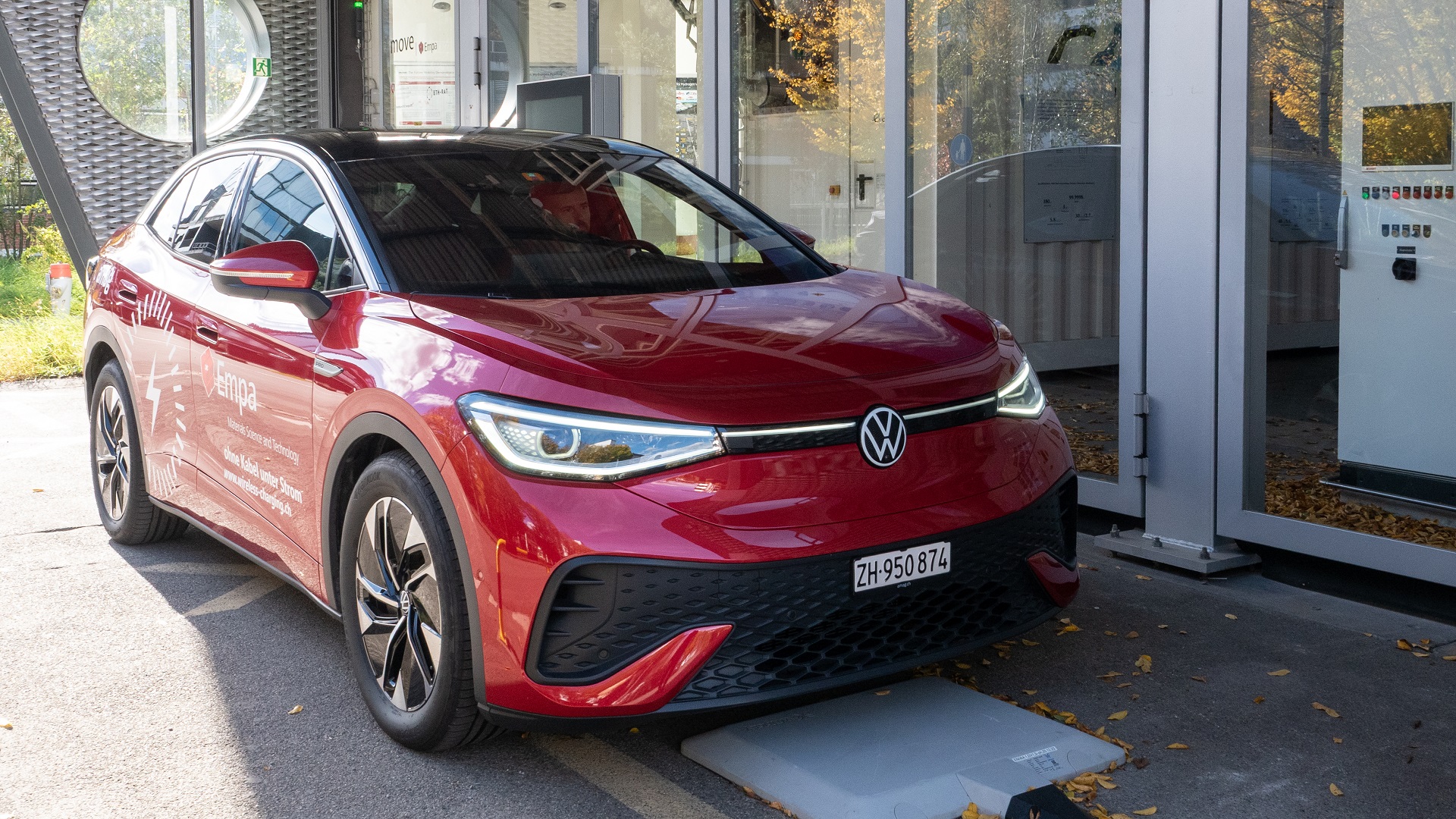
Bonus video of Swiss-German in the wild included. If you think German sounds harsh, you’ll love the Zuerich dialect. At least it’s all done in sing-song fashion, as is called for.
A real-world trial by scientists in Switzerland has demonstrated that wireless EV charging can achieve up to 90 percent efficiency compared with conventional cable-based systems, while offering far greater convenience.
Supported by the Swiss Federal Office of Energy and the cantons of Zurich and Aargau, the project, called INLADE, was carried out by researchers from Empa in collaboration with the electric utility Eniwa AG.
Through this first-of-its-kind initiative, the team tested wireless inductive charging under real-life conditions in Switzerland. They are certain that what has long been routine for phones and electric toothbrushes could soon become a reality for EVs.
“The aim was to test the existing technology in everyday use, clarify technical and regulatory issues and demonstrate its potential for the energy transition,” Mathias Huber, from Empa’s Chemical Energy Carriers and Vehicle Systems lab, said.
Why does the cars need to move?
Just build car charging coils into every parking spot, then have a computer keep track of what car arrived at what time, and give them an hour each of full charging sequentially.
Example
Car 1 parks in space A and starts charging, car 2 arrives shortly after and parks in space D, the computer logs the VIN and timestamp, placing it first in the queue. 30 min later car 3 arrives and parks in space B, the computer logs the VIN and time stamp, placing it second in the queue. Then car 2 leaves space D, the computer logs it and removes it from the queue, making car 3 first in line, then car 2 arrives back in space D, and is placed second in the queue since it left earlier.
No need to move tonnes of metal and batteries, just switching the power, a cheap and fair way to extend the number of charging spaces, while not overloading the circuit and ensuring that everyone gets a fair timeslot, all without having to risk dammage while moving the cars.
but then how do you make $?