This stuff is pretty much over my head, but if I understand correctly, the fact that the pilot’s feet (and body weight) aligned with the main thrusting mechanism (right under their feet) created a kind of advantageous situation not unlike a Segway, perhaps. Evidently it could make quick adjustments to its thrust patterns to prevent tipping, and in fact (again, like the Segway) actually used the pilots bodily leanings to steer in the desired direction.
Oh, yes, I see, it’s just a box with a jet turbine between your legs. No crash safety, and not much room for heat shielding so that must be fun after about 5 minutes.
The operator 44 achieves pitch control of the vehicle 10 for forward and rearward flight and roll control for sideways translation by leaning in the desired direction of flight.
Directional control of forward flight of the vehicle 10 is achieved by vanes 50 in the jet nozzle region of the engine 14. The vanes 50 are split so as to be actuated in opposite directions to swirl the exhaust of the engine 14 either in a clockwise or counterclockwise direction to cause the vehicle 10 to rotate in a counterclockwise or clockwise direction, respectively. The angle of the yaw vanes is controlled by the twist grip control handle 26 actuated directly by the operator’s hand through a conventional flexible cable or push rod control linkage, not shown.
So… the only real control is rotation (yaw). If a stiff breeze starts to tilt you over, there’s no way to recover.
You hope. There’s no control surfaces, and only the downward-pointed engine nozzle, so if it starts to tip over from a gust of wind or something there is no way to reorient it. There’s also no crash safety.
Its a gyroscope - the forces so long as its running are rather powerful.
A “gust of wind” would have to be powerful enough to overcome those forces. I’m just guessing, but I suspect we’re talking hurricane speeds.
Jet engines routinely rotate at many thousands of rpm, and basic force calculations show that speed/velocity are the single greatest energy/force metric as it’s influence is a squaring function - V is always represented as V^2 in these formulas.
Its why safety commercials for driving always say “Speed Kills” - mass doesn’t change and yet total energy in the system doubles with each single-unit increase in speed.
My point is that there’s a helluva lot of gyroscopic stability so long as that engine is spinning. I’d be more concerned about loss of that stability and lift than an outside force pushing it around.


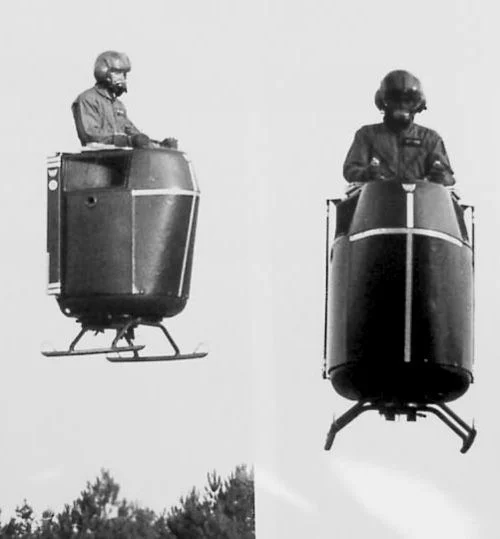
what exactly keeps this thing from flipping over?
The weight of the pilot’s balls acts as an efficient inertial stabilizer.
he must have https://www.youtube.com/watch?v=eckoYQqdk28
This stuff is pretty much over my head, but if I understand correctly, the fact that the pilot’s feet (and body weight) aligned with the main thrusting mechanism (right under their feet) created a kind of advantageous situation not unlike a Segway, perhaps. Evidently it could make quick adjustments to its thrust patterns to prevent tipping, and in fact (again, like the Segway) actually used the pilots bodily leanings to steer in the desired direction.
Of course, most important of all is that it was nicknamed the Flying Pulpit!
https://www.jetsprops.com/prototype/sky-high-dreams-and-grounded-realities-the-tale-of-the-x-jet.html
Found the patent which has diagrams of the inside https://patents.google.com/patent/US4447024
Oh, yes, I see, it’s just a box with a jet turbine between your legs. No crash safety, and not much room for heat shielding so that must be fun after about 5 minutes.
So… the only real control is rotation (yaw). If a stiff breeze starts to tilt you over, there’s no way to recover.
I think the turbine acts like a gyroscope, so it wants to remain vertical.
Then mrsemi makes a good argument too.
You hope. There’s no control surfaces, and only the downward-pointed engine nozzle, so if it starts to tip over from a gust of wind or something there is no way to reorient it. There’s also no crash safety.
Its a gyroscope - the forces so long as its running are rather powerful.
A “gust of wind” would have to be powerful enough to overcome those forces. I’m just guessing, but I suspect we’re talking hurricane speeds.
Jet engines routinely rotate at many thousands of rpm, and basic force calculations show that speed/velocity are the single greatest energy/force metric as it’s influence is a squaring function - V is always represented as V^2 in these formulas.
Its why safety commercials for driving always say “Speed Kills” - mass doesn’t change and yet total energy in the system doubles with each single-unit increase in speed.
My point is that there’s a helluva lot of gyroscopic stability so long as that engine is spinning. I’d be more concerned about loss of that stability and lift than an outside force pushing it around.