Japanese culture has some overlap with Chinese culture, but they existed separately long before the cultural exchange.
And the funny thing about the Japanese writing system is that they tried to write Japanese in pure Chinese characters but failed, so instead they invented kana and ended up with three different alphabets.
Still, the Kanji has become so uniquely Japanese that Chinese and Japanese are generally unintelligible between speakers who know the same characters because they often mean different things in their own language.
The Japanese kept the traditional forms but that doesn’t mean that they share the same meanings or that the Kanji are used in the same contexts to refer to the same things. The videos I shared touch on this. For example, 大丈夫 would confuse any Chinese reader of they had never come across the phrase before.
The pronunciations also evolved in Japanese. Kanji often have multiple on-yomi (Chinese) readings that changed depending on the era and the contemporary culture. And even then, those were interpretations of the Chinese pronunciations which sometimes don’t sound anything like Chinese.
I recommend reading the Kanji blog Fuusen no Arare if you study Japanese. It usually separates the on-yomi readings into go-on and kan-on, which are usually lumped together in other sources.


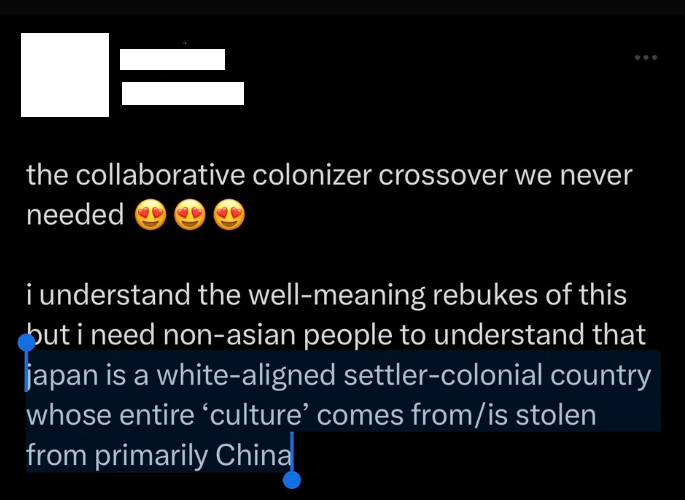
Japanese culture has some overlap with Chinese culture, but they existed separately long before the cultural exchange.
And the funny thing about the Japanese writing system is that they tried to write Japanese in pure Chinese characters but failed, so instead they invented kana and ended up with three different alphabets.
Still, the Kanji has become so uniquely Japanese that Chinese and Japanese are generally unintelligible between speakers who know the same characters because they often mean different things in their own language.
https://youtu.be/ZWsLahVQj9s
https://youtu.be/v2jw85SS3p4
Yeah, because chinese evolved, while japanese preserved the ‘original’ reading and meaning.
The Japanese kept the traditional forms but that doesn’t mean that they share the same meanings or that the Kanji are used in the same contexts to refer to the same things. The videos I shared touch on this. For example, 大丈夫 would confuse any Chinese reader of they had never come across the phrase before.
The pronunciations also evolved in Japanese. Kanji often have multiple on-yomi (Chinese) readings that changed depending on the era and the contemporary culture. And even then, those were interpretations of the Chinese pronunciations which sometimes don’t sound anything like Chinese.
I recommend reading the Kanji blog Fuusen no Arare if you study Japanese. It usually separates the on-yomi readings into go-on and kan-on, which are usually lumped together in other sources.
http://huusennarare.cocolog-nifty.com/