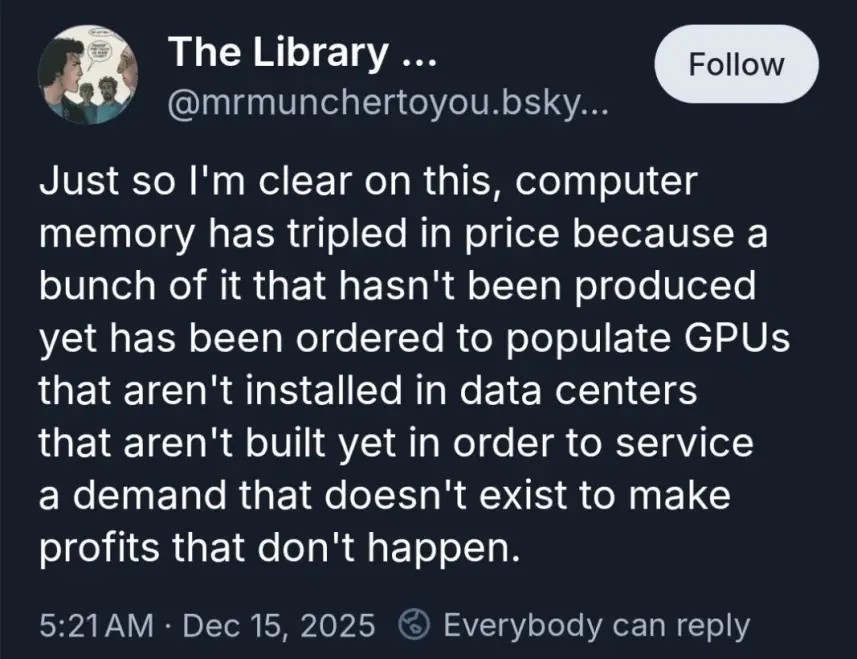
The key part of the statement is, “to service a demand that doesn’t exist.”
But that’s basically always true of big projects. The people financing the project believe that the demand will exist in the future, and know it will take time and investment of resources to get to the point where they will meet that future demand.
They can be wrong on their projections of future demand, but that happens all the time, too. A classic example is when a city hosts the Olympics or World Cup and builds out a lot of infrastructure to meet that anticipated demand for both that specific event and the long term needs of the resident population. Sometimes it works, like with certain mass transit systems expanded for those events, and sometimes it doesn’t, like when there are vacant stadiums sitting underused for decades after.
Or, the analogy I always draw is to the late 90’s when telecom was building it a bunch of fiber networks for the anticipated future demand for Internet connections. Most of those ended up in bankruptcy, with the fiber assets sold for a fraction of the cost of building them. But they still ended up being useful. Just not worth the cost.
I think the same will happen with a lot of the data center infrastructure. Data centers will still be useful. A lot of the infrastructure for supporting those data centers (power and cooling systems, racks, network connections) will still be useful. There’s just no guarantee that they’ll be worth what they cost to build. And when that happens, we might see a glut in used data-center-grade computing equipment, and maybe hobbyists will score some deals at auctions to make their own frankenservers for their own purposes, and completely blow normal homelabbing out of the water.
You are absolutely right in the overarching logic, but I believe we have interacted with the current iteration of AI long enough to know that consumer demand is underwhelming, and ROI for enterprise investment is near zero.
In your Olympics analogy, it would be like every four years a city spending tons of money on Olympic games that attract a lot fewer visitors than predicted, just because the other cities did in the past.
Honestly, I am reminded of the early days of the Internet, when all VCs were funding “generic sales startup” because they had said No to Bezos and Amazon had exploded. It wasn’t about making a good investment, it was about being able to say they hadn’t slept on the biggest opportunity they in fact missed.
All those data centers will be of little use. The components used are deliberately e-waste, designed to die in 5 years or less. The rack space is the cheapest part and if there’s no demand, they will be quickly deprecating real state. Anything built will be demolished and sold as soon as the bubble bursts. That’s their usual destiny, as data centers are not a very profitable for lease space.

But that’s basically always true of big projects. The people financing the project believe that the demand will exist in the future, and know it will take time and investment of resources to get to the point where they will meet that future demand.
They can be wrong on their projections of future demand, but that happens all the time, too. A classic example is when a city hosts the Olympics or World Cup and builds out a lot of infrastructure to meet that anticipated demand for both that specific event and the long term needs of the resident population. Sometimes it works, like with certain mass transit systems expanded for those events, and sometimes it doesn’t, like when there are vacant stadiums sitting underused for decades after.
Or, the analogy I always draw is to the late 90’s when telecom was building it a bunch of fiber networks for the anticipated future demand for Internet connections. Most of those ended up in bankruptcy, with the fiber assets sold for a fraction of the cost of building them. But they still ended up being useful. Just not worth the cost.
I think the same will happen with a lot of the data center infrastructure. Data centers will still be useful. A lot of the infrastructure for supporting those data centers (power and cooling systems, racks, network connections) will still be useful. There’s just no guarantee that they’ll be worth what they cost to build. And when that happens, we might see a glut in used data-center-grade computing equipment, and maybe hobbyists will score some deals at auctions to make their own frankenservers for their own purposes, and completely blow normal homelabbing out of the water.
You are absolutely right in the overarching logic, but I believe we have interacted with the current iteration of AI long enough to know that consumer demand is underwhelming, and ROI for enterprise investment is near zero.
In your Olympics analogy, it would be like every four years a city spending tons of money on Olympic games that attract a lot fewer visitors than predicted, just because the other cities did in the past.
Honestly, I am reminded of the early days of the Internet, when all VCs were funding “generic sales startup” because they had said No to Bezos and Amazon had exploded. It wasn’t about making a good investment, it was about being able to say they hadn’t slept on the biggest opportunity they in fact missed.
All those data centers will be of little use. The components used are deliberately e-waste, designed to die in 5 years or less. The rack space is the cheapest part and if there’s no demand, they will be quickly deprecating real state. Anything built will be demolished and sold as soon as the bubble bursts. That’s their usual destiny, as data centers are not a very profitable for lease space.