

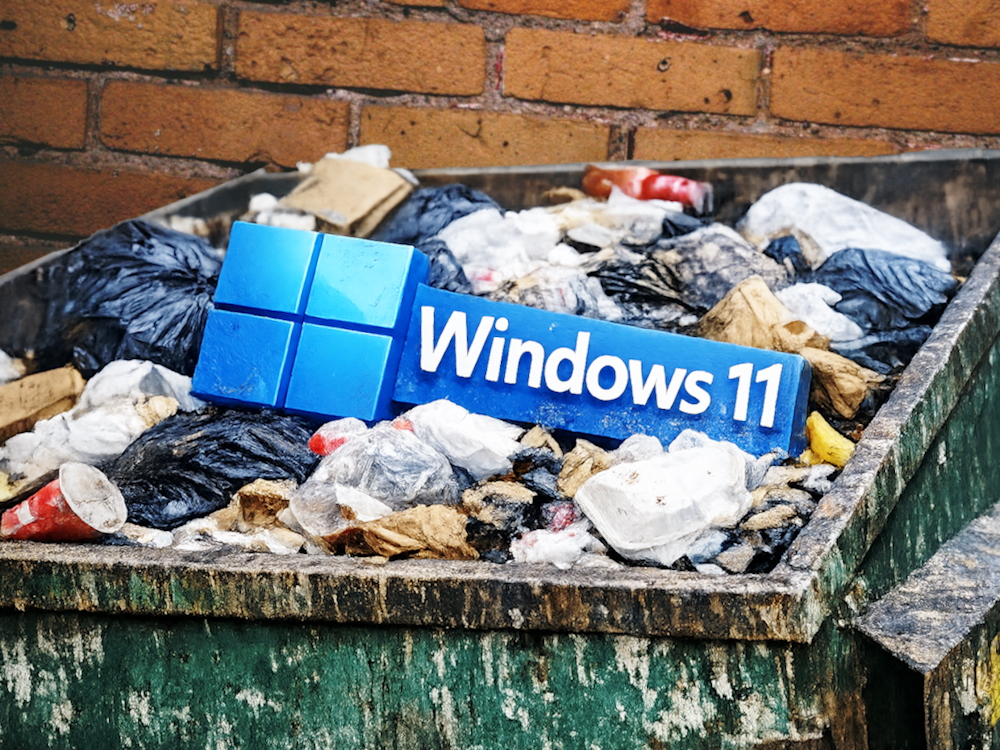
There. That’s out of the way. I recently installed Linux on my main desktop computer and work laptop, overwriting the Windows partition completely. Essentially, I deleted the primary operating system from the two computers I use the most, day in and day out, instead trusting all of my personal and work computing needs to the Open Source community. This has been a growing trend, and I hopped on the bandwagon, but for good reasons. Some of those reasons might pertain to you and convince you to finally make the jump as well. Here’s my experience.
[…]
It’s no secret that Windows 11 harvests data like a pumpkin farmer in October, and there is no easy way (and sometimes no way at all) to stop it. The operating system itself acts exactly like what was called “spyware” a decade or so ago, pulling every piece of data it can about its current user. This data includes (but is far from limited to) hardware information, specific apps and software used, usage trends, and more. With the advent of AI, Microsoft made headlines with Copilot, an artificial assistant designed to help users by capturing their data with tools like Recall.
[…]
After dealing with these issues and trying to solve them with workarounds, I dual-booted a Linux partition for a few weeks. After a Windows update (that I didn’t choose to do) wiped that partition and, consequently, the Linux installation, I decided to go whole-hog: I deleted Windows 11 and used the entire drive for Linux.
To be fair, this is perpetuated pretty hard by YouTubers/influencers.
“Omg I switched to $DISTRO and it BEATS Windows in gaming!” “No issues!” “Printers just work!” “OnlyOffice is compatible with MS Office!”
And then when you “switch” to Linux and you get sub-par performance and everyone’s answers on forums are:
I just installed Cachy on my old spare gaming desktop(1700X cpu) and immediately was met with odd performance issues. Come to find out that the cpu frequency scheduler doesn’t like my CPU and was causing it go from 1.8GHz to 3.6GHz rapidly, wattage flip flopping between 15w-45w, fps in game going from 20fps to 80fps without even moving…I got most of it fixed by forcing performance mode via cpupower, but I still have lower fps than windows and the only thing I can find online is that proton overhead is too much for my CPU so I bought a 3700X for $100 on eBay. But all of my solutions I had to find myself because reddit was too busy arguing than troubleshooting.
I do feel what you’re trying to convey and I completely understand since linux is my daily driver but I always had a dual boot setup for the occasional windows thing.
But my here’s my 2 eurocents: if companies like Adobe (or Valve or whatever) had the grace to build their tools/utils/games for Linux the adoption would be far more widespread.
And the joke is, they would not invest time to build stuff for Linux because the Linux adoption is quite low compared to other platform. Linux does not have sub-par performance, it’s just the software, for example all Stadia games were native games running on a custom Debian, with amazing performance and high FPS via streaming. Unthinkable to achieve the same with a Windows or a Mac OS