You claim anecdotally that a lesbian wouldn’t say they scissor.
Pointing out that they do say it suffices.
Your experience doesn’t encompass all lesbians of every generation, so we can refer to LGBT+ publications, direct anecdotes, history, & scholarly research.
We have direct anecdotes from a podcast & affirming comments.
The wikipedia article even calls out exactly what you’re doing & cites scholarly research.
It explains with references that it is or was common for some tribadists not to recognize that word (or variants) & use scissoring more broadly to describe their activity.
Elsewhere, you add that a specific sense of scissoring (that the comic didn’t specify) of rubbing genitals together isn’t real.
The cited references have some interesting quotes.
In a Hite report
Sex with a woman for me has involved kissing, feeling one another completely, and basically humping – pressing mound of Venus against mound of Venus or each other’s leg.
Another cited reference explains tribade historically meant a woman taking the role of penetrator (with dildo or clitoris) before describing Anne Lister’s diary where she mentions genital to genital contact in her tribadism.
Most of their sexual activity seems to involve Anne touching Mrs. Barlow’s “queer” (as she calls the female genitals) and tribadically rubbing on her.
Anne manipulates Mrs. Barlow digitally but would prefer full-body tribadism, queer to queer, as she says elsewhere.
So, they do say they do that, too, even ages ago.
As for the ngram viewer, it’s not essential, however
we’re only reviewing recent texts with high quality OCR, so OCR issues don’t apply: OCR improved, not poorly printed archaic texts, tribbing doesn’t contain mistakable characters like long sſ so OCR error should be uniform, not Chinese or a language difficult for OCR.
It indicates tribbing hasn’t historically appeared in print much.
While I appreciate the time you put into this, you haven’t really addressed my criticism - that podcast spends ~30 seconds on the topic, and even as explained in the article from whatever pride.com is, do not make a concrete statement beyond their own impressions. They even explicitly say that they feel like they are in the minority and that the prevailing attitude of lesbians is that we/they as a group don’t scissor. Also, there is a single comment on that page in support of their presentation of scissoring. That’s… not a plurality of support, nor is the podcast’s comment at odds with their own characterization of the culture surrounding the act presented in the podcast itself.
I’m not sure what your goal is with presenting the history of the term, but it is interesting to see the wikipedia article rewritten so succinctly, thank you!
Ngram viewer - it’s a representation of the data contained within it yes, as their initial paper says, but the way you’re using it here is at perfect odds with your own characterization of the service:
it’s true the corpora don’t reflect general language & culture
Which is what you’re claiming it does. If you’re shifting it to mean that tribbing hasn’t appeared in print much, I already agreed and my hypothetical addresses exactly this issue, as does the excerpt on the criticism of Google Ngram. Also wikipedia directly addresses this:
Scissoring is commonly used as an umbrella term for all forms of tribadism, and many lesbian and bisexual women are unaware that some of the sexual acts they include in their lovemaking are aspects of and are formally labeled tribadism, as tribadism is commonly omitted from mainstream sex research.
So there’s really not much to be said about it’s frequency of use in print media, just about the driving reasons behind it.


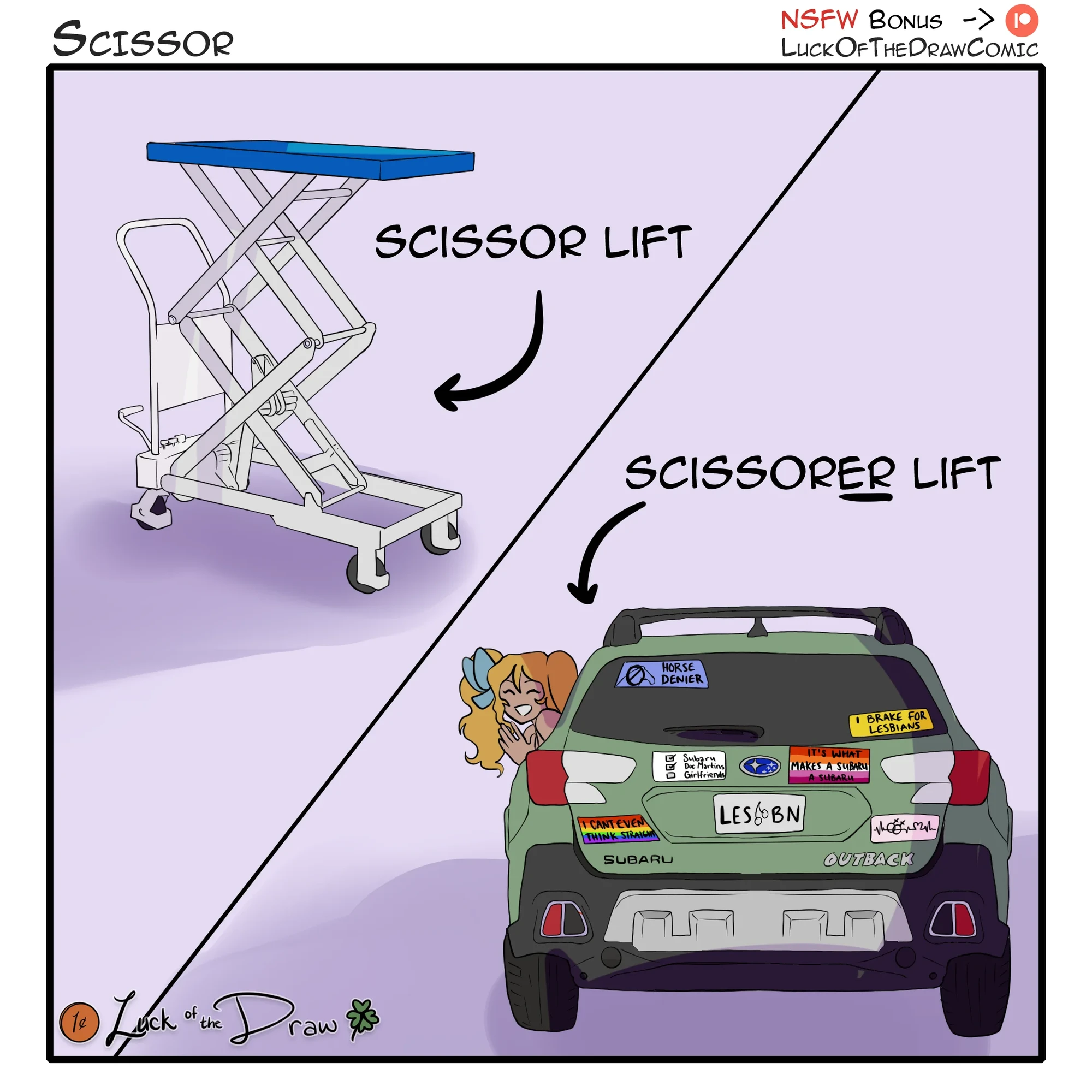
You claim anecdotally that a lesbian wouldn’t say they scissor. Pointing out that they do say it suffices. Your experience doesn’t encompass all lesbians of every generation, so we can refer to LGBT+ publications, direct anecdotes, history, & scholarly research. We have direct anecdotes from a podcast & affirming comments. The wikipedia article even calls out exactly what you’re doing & cites scholarly research. It explains with references that it is or was common for some tribadists not to recognize that word (or variants) & use scissoring more broadly to describe their activity.
Elsewhere, you add that a specific sense of scissoring (that the comic didn’t specify) of rubbing genitals together isn’t real. The cited references have some interesting quotes. In a Hite report
Another cited reference explains tribade historically meant a woman taking the role of penetrator (with dildo or clitoris) before describing Anne Lister’s diary where she mentions genital to genital contact in her tribadism.
So, they do say they do that, too, even ages ago.
As for the ngram viewer, it’s not essential, however
ſso OCR error should be uniform, not Chinese or a language difficult for OCR.It indicates tribbing hasn’t historically appeared in print much.
While I appreciate the time you put into this, you haven’t really addressed my criticism - that podcast spends ~30 seconds on the topic, and even as explained in the article from whatever pride.com is, do not make a concrete statement beyond their own impressions. They even explicitly say that they feel like they are in the minority and that the prevailing attitude of lesbians is that we/they as a group don’t scissor. Also, there is a single comment on that page in support of their presentation of scissoring. That’s… not a plurality of support, nor is the podcast’s comment at odds with their own characterization of the culture surrounding the act presented in the podcast itself.
I’m not sure what your goal is with presenting the history of the term, but it is interesting to see the wikipedia article rewritten so succinctly, thank you!
Ngram viewer - it’s a representation of the data contained within it yes, as their initial paper says, but the way you’re using it here is at perfect odds with your own characterization of the service:
Which is what you’re claiming it does. If you’re shifting it to mean that tribbing hasn’t appeared in print much, I already agreed and my hypothetical addresses exactly this issue, as does the excerpt on the criticism of Google Ngram. Also wikipedia directly addresses this:
So there’s really not much to be said about it’s frequency of use in print media, just about the driving reasons behind it.