

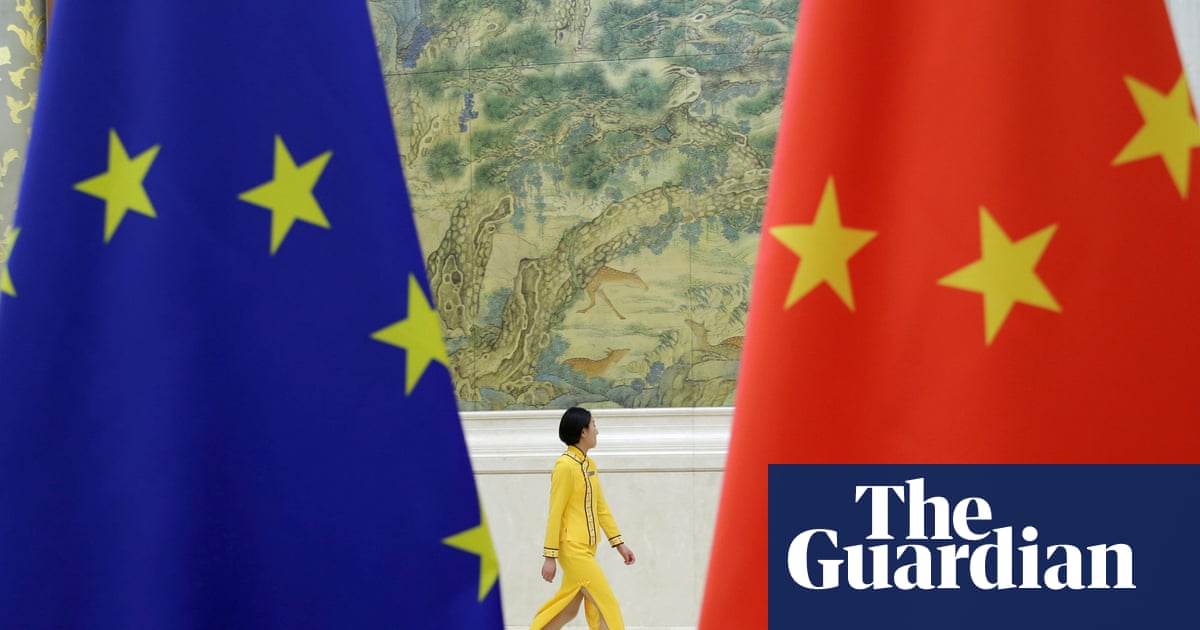
Chinese officials are using a ‘highly specific’ interpretation of EU rules to suggest Taiwanese figures should not be granted visas, EU officials say.
Chinese officials have been pushing “legal advice” on European countries, saying their own border laws require them to ban entry to Taiwanese politicians, according to more than half a dozen diplomats and officials familiar with the matter.
The officials made demarches to European embassies in Beijing, or through local embassies directly to European governments in their capital cities, warning the European countries not to “trample on China’s red lines”, according to the European diplomats and ministries who spoke to the Guardian.
The manner of the approaches varied – some to individual countries and some as groups, some by written note verbale (a semiformal diplomatic communication) and others in person. They occurred in November and December, and were at least partly in response to recent European trips by Taiwanese officials including its current vice-president and foreign minister, and a former president.
…
Beijing said it “respects the sovereignty of the European side in introducing and implementing visa policy”, but an “institutional loophole” had allowed frequent visits by Taiwan politicians.
…
The officials’ suggestion, the Guardian understands, was that allowing Taiwanese officials to enter a European country would threaten that country’s international relations with China.
In some cases they also referred to the Vienna convention on diplomatic relations, or suggested the European countries follow the UN’s example and bar all Taiwanese people from government buildings, the Guardian was told.
“Beijing’s application and interpretation of this regulation is bold,” said Zsuzsa Anna Ferenczy, assistant professor at Taiwan’s National Dong Hwa University, when told about the moves. “It is Beijing’s interpretation that EU-Taiwan ties threaten EU-China ties. This is not at all the perception or reality in Europe.”
…
The [Chinese] note verbale said European countries should reject any “so-called diplomatic passports” issued by Taiwan, and “prohibit Taiwanese personnel from entering Europe to seek official contact and exchanges and trample on China’s red line”.
“China hopes the EU institutions and European countries will, out of the larger interests of China-EU relations and bilateral relations, make the political decision of refusing the entry of Taiwan’s so-called president or vice president (former ones included),” it said, also listing other officials.
The note cited visits by the officials to Belgium, the Czech Republic, Poland, the Netherlands, Italy, Australia, Germany, Lithuania, Denmark, Estonia and Ireland, saying they “seriously undermine China-EU relations”.
…
“The European side … even indulged [vice-president] Hsiao Bi-khim to speak at the building of the European parliament and promote ‘Taiwan independence’ separatist claims,” it said, referring to a speech given by Hsiao to the annual summit of the Inter-Parliamentary Alliance on China (Ipac) in Brussels.
…
A spokesperson for the UK Foreign Office said: “Permission to enter the UK is determined solely by our own laws and immigration rules, which apply equally to those travelling from Taiwan.”
Taiwan’s foreign ministry said officials’ visits to Europe were “entirely unrelated to China, and China has no right to interfere”.
“On the contrary, China’s use of various coercive measures against other countries and its threats of force against Taiwan, which undermine global and Indo-Pacific peace and stability and threaten the direct interests of the EU, is the real force damaging European international relations,” the spokesperson told the Guardian.
…
“I see this as another way to generate unease among member states that their relations with the [People’s Republic of China] might be at risk … and Beijing knows well that some EU member states are very keen to attract Chinese investment at present,” said Ferenczy.
The EU does not take a position on Taiwan’s status, and while it has formal relations with Beijing it also maintains “solid” unofficial relations with Taipei through parliamentary diplomacy and trade. Several European countries and the EU have trade offices that act as unofficial embassies in Taipei.
…
However in recent years the bloc has come under increasing pressure from Beijing, which claims Taiwan as a province of China, and intends to annex it – by force if necessary. Among its strategies to coerce Taiwan into accepting unification without conflict, Beijing puts intense diplomatic pressure on the international community to isolate Taipei from multilateral engagement.
…