That’s my point. “F” should be labiodental, “ph” should be bilabial. It’s not the “accepted” way, that phoneme doesn’t really exist in English, but it should.
Not really keen on sharing my voice online. It sounds almost identical, just a little softer. You can try it yourself: wherever there’s a “ph”, put your lips together as if it were a “p”, then separate them the tiniest bit and push air through like an “f”.
Kinda like you’re blowing off soup, but without pursing your lips. I think it’s basically like the embouchure for a single reed woodwind.

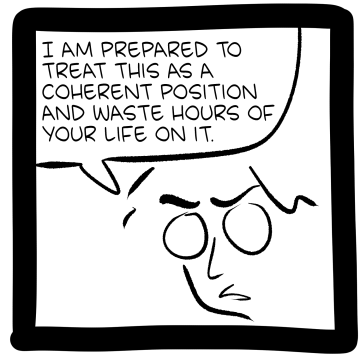
![[SMBC] JPEG](https://lemmy.world/pictrs/image/2f500de2-cd40-4b23-ba8d-96b95aa34ec2.png)
I’m going to go further and say “ph” should always be pronounced [Φ]
For some reason, very few people seem to care about this.
An even though I do care, I don’t do so enough to try and undo my bad pronunciation.
F-eye-otograf-eye?
The voiceless bilabial fricative
It’s funnier with the Greek letter.
Also, the vid you linked says “labial to labial” but as a American English speaker, I have never two-lipped an F sound. Top lip is on my teeth…
That’s my point. “F” should be labiodental, “ph” should be bilabial. It’s not the “accepted” way, that phoneme doesn’t really exist in English, but it should.
Interesting. Can you record yourself saying “photograph” with two bilabial [Φ]s?
Not really keen on sharing my voice online. It sounds almost identical, just a little softer. You can try it yourself: wherever there’s a “ph”, put your lips together as if it were a “p”, then separate them the tiniest bit and push air through like an “f”.
Kinda like you’re blowing off soup, but without pursing your lips. I think it’s basically like the embouchure for a single reed woodwind.
the voiced bilabial fricative is /m/
how do you make an /f/ sound- voiced or not - with your lips closed?
edit: nvm, I watched the video, it’s for non-english speakers and doesn’t really work without releasing into a vowel.