One of my pet peeves of modern fantasy media is the notion that some people are “special” - and thus implied to be “better” - than other people because of some inherent magical ability. One of the best-known modern examples of this is the Harry Potter franchise, where the protagonists are mostly mages, and even the characters who actually care about the welfare of the latter do so in an extremely patronizing way - i.e. by stopping the “bad mages” rather than working together.
In #dnd and similar #ttrpg, the concept is represent by the “sorcerer” and similar characters who gained their cool powers from some innate birth ability rather than study and hard work.
And while there is nothing wrong with wanting to play such a character, just for once I would like to see an in-setting examination of what it means to have this privilege, instead of the more common:
“Oh no, woe is me, I have been born with special powers and will be hated and persecuted for them. Thus, I must spend most of my time in a secret society with my fellow very special people!”
To be clear, people born with privilege did not ask to be born with privilege, and cannot be blamed for that. However, they should also acknowledge that they have this privilege, and not assume that they are somehow “better” than people without it.
I don’t know… The whole “We’re so special” part of sorcs always felt like over compensating to me. People who don’t have innate magic can cast a wider variety of stuff than they ever can. The person who learned it from the ground up, instead of just inheriting it, can do anything they want with it, unlike a sorc.
I like Midgard, the first German fantasy ttrpg, in that regard. Every character has magic talent as a stat like dexterity, strength or int. When starting out, only some classes have already learned to use that inherent ability everyone has but there’s rules for learning magic for non magic classes. Granted this cost a helluva lot of exp to do but it is possible and takes a bit away from that special people factor
don’t most systems relate magic to a stat. int, wis, cha in the case of pathfinder and dNd? Like in pathfinder your to hit and damage with spells are effected by your key stat. That seems more natural to me. having a magic talent stat is like having a non magic talent stat. to generic over str/dex or such. Granted I wish the magic systems split them more up on both sides. dex and int being to hit and str/cha being damage (although I hate cha as opposed to a word like will power or prescence or such)
The important part here is that it’s an extra stat that everyone has. It’s not like DnD or Pathfinder where you know magic and your modifier comes from one of your normal stats and everyone else does not know magic. Magic Talent is an extra that every class has and every class can eventually make use of if they live long enough. It’s also the implication that you don’t have a magic on/off switch that is rolled at birth. Everyone has that possibility but has to go through training to use it.
I just don’t get it it though. shouldn’t everyone have a mundane talent score then that dictates how good one is with mundane tasks like swining a sword or picking a lock? with pathfinder and dnd there is special magic talent but also mgic comes from study or gifted by entities and the ability to do that relies on stats the same as stats help you be a better warrior or thief. if anything the magic talent stat sounds like an on off switch.
RuneQuest does a similar thing: Everyone can do magic on a basic level, but it takes skill and time to become proficient. To me this always made more sense than the “chosen one” logic inherent in other RPG systems, because most RPG classes are inherently defined by a difference in skill.
In D&D sorcerers started in Dragonlance after the Chaos War left Krynn without magic. Palin Majere became the first sorcerer, having already been a wizard, when an aspect of Takhisis taught it to him. It wasn’t innate, but it was spontaneous rather than vancian. There were also mystics, which were similar but divine rather than arcane, but when the sorcerer class was picked up for 3e they weren’t included.
The main takeaway from sorcerers though isn’t that they’re somehow “special”, it’s that they don’t have to memorize spells. Their magic is innate because they’re related to a creature type that gets spell-like abilities. Same as plenty of other types of characters who have SLAs, like drow or furbolgs or numerous other creatures.
If anything, the association with wild magic probably works to their detriment socially. Wizards have arcane magic, but at least they know how it works. I’m not really sure where you’re drawing a connection between the social stigma of unpredictable magic and being treated as “better” than anyone. I haven’t seen lore that supports the idea.
@juergen_hubert It’s tricky to build a setting that actually examines this sort of privilege not just because we know how people born to privilege behave in the real world (forming an aristocratic class and - if pressed - coming up some sort of narrative like noblesse oblige or divine Right of Kings), but also because well before 3rd edition’s take on sorcerers was a thing, many medieval fantasy worlds had people born to unearned magical power and privilege: gods.
A setting with divinities who are actively using their power to better the world can easily make the inborn power of a typical PC or point of view character feel irrelevant. OTOH those which feature apparently-inactive deities probably inspire many born to power to worry about themselves first, and others second (or never)
@juergen_hubert I think this type of setting gets even harder to build when we base the discussion on D&D sorcerers. For all they may be born to a certain amount of power compared to an ordinary person, they have to put themselves through real effort and danger to progress from there - they really don’t get that much for free (c.f. characters in Zelazny’s Amber).
The Deriny cycle by Kurtz is actually pretty great. You have some super human having access to some magic. And throagh the books they go for m super elite to persecuted minority before being accepted again.
Magic being either genetic on ea random birth gift would indeed have a major sociological impact. But in a setting where we have high magic, elves and dragon the whole sociology is anyway impacted
I feel like the Dragon Age series has a nice take on it. Oh, you’ve been born with magic? Great, time to take you away from your home and family and put you in a tower with other mages where you’ll be under constant guard by mage hunters for the rest of your life. See you never <3
I’d also like to see it come with relevant costs. Much in the same way genius and madness often go hand in hand. Not full on oracle’s curse, more like how some beautiful people struggle being taken seriously or respected for their minds, or how some neurodivergent people just get difficult subjects while struggling with aspects of ordinary life.
But yeah generally I’m in full agreement with you. Show me the half orc who only got a chance in their hometown because they’re a sorcerer and that resulted in complicated emotions. Show me the noble whose family paid good money for their child to be a sorcerer and now they’re off trying to prove themselves. Show me a society in which a sorcerer child is considered an unimaginable blessing even though that bloodline may leave their sibling a hated tiefling and then use it to show a golden child/scapegoat sibling dynamic enforced not necessarily by the parents, but by the whole community.
The Locked Tomb did both. Necromancers are a blessing and privileged. There are roles in society only they’re allowed to fill. But they’re also chronically ill. They’re frail and sickly and look and feel like they’re dying. That actually would give credence to if they were to not like being like that.
Ok now I want to play a noble sorcerer who’s parents paid a massive price for her powers and is now struggling with the guilt and expectations. Harrowhark Nonagesimus meets Lorelai Gilmore
Let it go 🎶
Yes but imagine she’s slumming it with a bunch of adventurers because she can’t deal with her parents at the moment
I know y’all are talking about like, buying a wish spell, but y’all make it sound like the mom hired a magic gigolo XD
I’m thinking pact with a demon, fae, or a dragon. Imagine the family fortune went to a dragon for draconic magic to make you a sorcerer. Or mom gave a sense to a fairy for it. Or just a sold soul. Or yeah magic reproductive material donors
To my fair for DnD does imply that all player characters are special and that’s why they can do what they do. Especially when the magical classes. All priests can say the words but only those blessed will manifest the clerical / druidic magics. They are the special ones but still have to learn to power up.
Also it’s not as binary in Dnd. There’s a reason not every NPC is high level regardless of age. Most settings have implied that at a certain point a spellcaster maxes out the spells they can do. All those casters who can do 1st level spells only some are implied to be still learning but others are just as good as they can be.
So there’s isn’t one class that is special but all of them
While the Eberron setting doesn’t directly tie dragonmarks to the Sorcerer class, it does explore hereditary magic as a privilege. In general, if you’re not of the bloodlines who are “supposed to” get particular constructive magic and want to go into business using that magic, you need to either sign a contract with the appropriate Dragonmarked House or they’ll go Pinkerton on your ass. This cuts the other way, too, where anyone in the House with such powers is pressured to participate.
Eberron is one of my favorite DnDoid settings, precisely because the designers put a lot of thoughts into this stuff.
Referring back to my “sorcerers have a superhero origin” proposal elsewhere in this discussion… one of the Dragon suggestions for an alternative source of inherent magical power is being the subject of magical or alchemical experimentation.
In Eberron, since it just came out of a massive war that involved advancements in combat magic and artifice, it’s easy to imagine that type of origin specifically manifesting as “Captain America, but a sorcerer”.
Keith Baker always encouraged this kind of creative reskinning of classes.
And, of course, the privilege of superbeings has been explored in #ttrpg before, such as in the setting of Aberrant.
Sounds like a GM problem. It’s been pretty clear to me when I read Eberron back then (never been much of a DnD head) that sorcerers were “talented children” assholes, as opposed to the raging wizard nerds who had studied to get there.
Not using this dynamic is completely on your GM and player group in general. And it’s a damn shame!
I wonder if innate magic could be an analog to natural intelligence? People are born on a bell curve, and you can’t change your genetics, but you can work with what you have.
So less like the black and white world of Harry Potter, where you have magic or don’t, and more like magic talents in Xanth, where everyone gets a magic talent, and people with really powerful ones tend to be interesting and go on to do great things.
The thing about society though is that intelligence doesn’t always mean you will contribute. Some “smart” people exploit others and amass wealth.
Racism and prejudice are missing from your equation. The sorcerer is different but only treated special in character creation because they get free shit. In the world they would be hated and feared as the person who started fires as a child or drowned a local cow. They would have a rumor of death or destruction follow them wherever they go
Good on your for not thinking of how much your personal frustrations would impact the behavior of the world. It’s hard to think beyond prejudice and racism.
People hate different people for existing and different people exist: they can be called “special” but they are still different. And special people exist. That’s what makes Einstein and Mozart and many others stand out in history. Differences exist. How your world treats them is what makes a good story.
> In the world they would be hated and feared as the person who started fires as a child or drowned a local cow.
Would they, though? Or would they end up in an upper class that controls world leaders from back rooms while looking like flashy celebrities in public? Because the takeaway from the real world is that racists hate on people they see as less powerful than them, and sorcerers are categorically not that.
Now you’ve inspired me. I should make a character who’s 1 level in sorcerer, the rest in wizard, and the premise is that they set out to prove everyone wrong that they’re not just going to rely on their inborn talents and they’re ready to do the work!
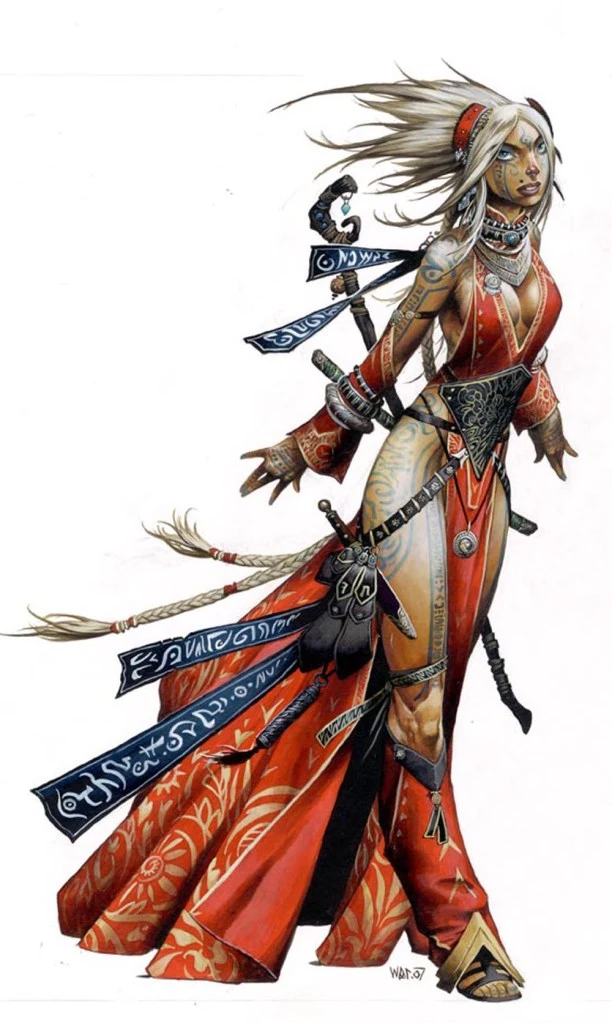
Who the pretty lady
Seoni, the “Iconic Sorcerer” from the Pathfinder RPG.
I’m glad 2e gave her more realistic clothing while honoring her original “aesthetic”
And here I am, looking for Pockets in her dress.
“The privilege of sorcerers”
waow…
Seoni, the iconic sorcerer of Pathfinder.
I’ll note that one thing that bugs me about the Sorcerer class *is* that, despite how fairly early in D&D 3e’s life there was a Dragon article talking about many alternative ways to have innate magic other than being born with it, both D&D itself and Pathfinder after it doubled down on the “magical bloodline” lore and terminology.
My preference is more “wizards have an education, warlocks have a magic sugar daddy, sorcerers have a superhero origin”.
> sorcerers have a superhero origin
This is Oracle erasure.