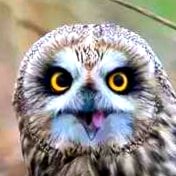

From Raptors Rise Rehab Center
Sweet Barry came to us on October 30th. He had been struck by a vehicle and had a concussion as well as a badly broken beak. With time and a good vitamin enriched diet, his beak is healing well! We chopped his food for him for a long while. We do regular trimming, smoothing and shaping as the beak grows. He now can tear meat once again. Barry should be going free in early Spring! He’s been the best patient and guest!

We’ve discussed coping before, where the beak is trimmed if it grows too long. This is a bit of the opposite, where the beak has been broken off and now has to grow back.
There was an intake photo shared, but I left it out since it was pretty gory. This owl would have been in serious pain and trouble if someone hadn’t rescued it. Now it gets a second chance in life.
Go Barry! You can’t keep a good owl down!
Oh nice, I had no idea their beaks could heal like that. It’s amazing that he’ll be able to be released. Usually once an animal has been consistently fed by humans it becomes dependent. I suppose the small size of their brains is sometimes an advantage 😉
The keratin layer on the outside grows just like a fingernail, as in the wild it wears down with use.
There are bone layers underneath, which can regrow, but injuries to that are much more painful and take a long time to grow back if they are not damaged too badly.
I did find this story from World Bird Sanctuary of this bald eagle that was shot, almost severing the top of the beak! 😮
Progress Images (fairly graphic)

There is no way that bird would have survived on its own, but with a dedicated team of caregivers, it is biologically possible. They said this progress took 7 surgeries, and probably another 6 months from now, a year from that last photo, for that keratin to finish growing after the bone repair.
They discussed how even with over a year’s worth of care, it is still not adapted to being around people. Coming in as an adult animal, it likely won’t ever be happy with humans. I attended a seminar about this balance of ongoing stress vs ongoing care recently, and it went into much detail about this. Here is a quote from WBS discussing it in regards to this eagle.
Part of the Wildlife Rehabilitator’s Code of Ethics is that “Non-releasable animals have a right to euthanasia.” This is listed as the animal’s right because most wild animals do not adapt well to life under human care and keeping them would result in lifelong stress to the animal. While rehabilitative care is itself stressful, it is provided with the understanding that the benefit of eventual release outweighs the temporary stress of care.
Doing well in a rehab setting is very different than the ability to do well in a permanent care setting. In rehab, we are still as hands off as possible. 390 is in a quiet place away from human activity, and he only has to see humans for his daily feeding and aviary cleaning. He is still not a big fan of us, but knows the routine and is much less stressed by it than he was. If kept permanently under human care, he would not be able to stay in this quiet setting.
In order to be placed somewhere, wildlife legally has to serve some form of purpose, they can’t just be kept quietly behind the scenes. This means 390 could be in display aviary, used as a gloved ambassador animal, or as a foster parent. We would have to assess if he could continue to have a low stress, good quality life in one of these settings. If the answer is no, it is 390’s right to be humanely euthanized rather than kept somewhere he would be perpetually miserable.
Most of us would probably not enjoy being kept in an alien zoo, away from our real homes and our own kind, even if they aren’t hurting us. It is much the same for the great majority of wild animals in human care.
Thanks for taking the time to type this out!
Of course! This is why I love participating here so much. Most of this info was new to me as well. I know a lot of basic facts by now, but these more specific conversations give me opportunities to dive deeper on more specific things.
The eagle’s story is also so amazing! The spirit of that bird fighting through the pain, all the work of the people to heal it, and all this is still just people giving of themselves with time and resources, as it is all donation based work. It took so many individuals to make this story happen, and this happens so many times a day, all over the world. I think it is tremendously inspiring.

