Could be three types of lighting divided into two spacial zones. Might be commercial (or industrial) where it’s nice to have all the switches by the door to turn everything off at once (but still have the option of only lighting one half if that’s where all the work is being done that day).
I don’t think it’s all that uncommon to see in houses with recessed light fixtures, 1970s-90s type stuff. Couple 3-ways for hallway lights (also controlled elsewhere in the hallways), 1 (or 2) for ceiling fan (2 if it has lights and wired as such), rest for banks of recessed lights so someone could use lower wattage incandescents in some. I think this nonsense mostly died out with shag carpeting tho


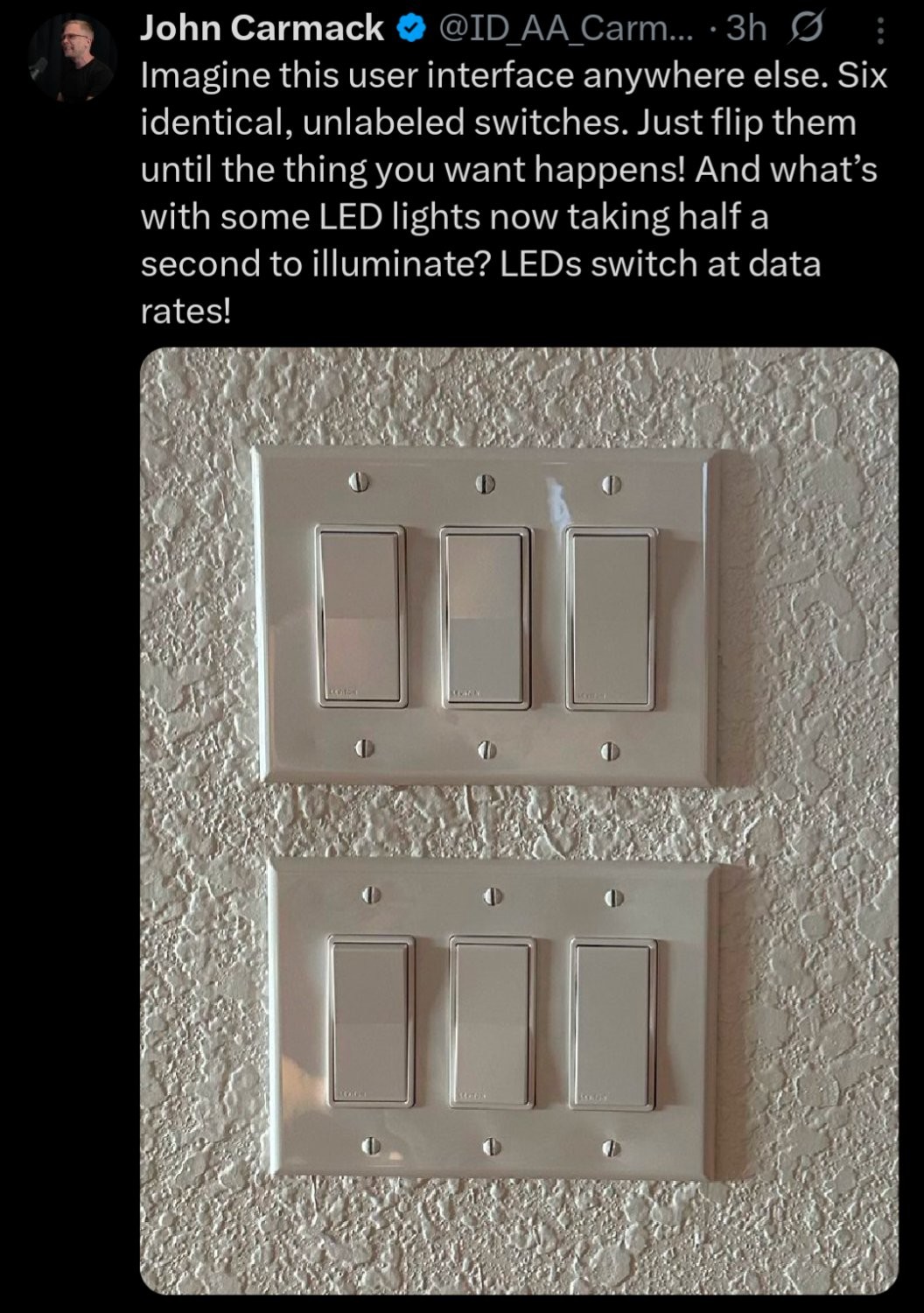
Unless it is a very big square-ish room with 6 lights at the ceiling.
There isn’t likely to be a good reason for each light to be individually controlled instead of having one switch for all six.
Don’t get me wrong, lights could be put in multiple groups (ambient lighting, task lighting, etc.) but six of them is more than a stretch.
Could be three types of lighting divided into two spacial zones. Might be commercial (or industrial) where it’s nice to have all the switches by the door to turn everything off at once (but still have the option of only lighting one half if that’s where all the work is being done that day).
Maybe they sometimes want only some of them on and haven’t heard of dimmer switches?
I don’t think it’s all that uncommon to see in houses with recessed light fixtures, 1970s-90s type stuff. Couple 3-ways for hallway lights (also controlled elsewhere in the hallways), 1 (or 2) for ceiling fan (2 if it has lights and wired as such), rest for banks of recessed lights so someone could use lower wattage incandescents in some. I think this nonsense mostly died out with shag carpeting tho