The title is pretty vague. This seems to be the core of it from the article:
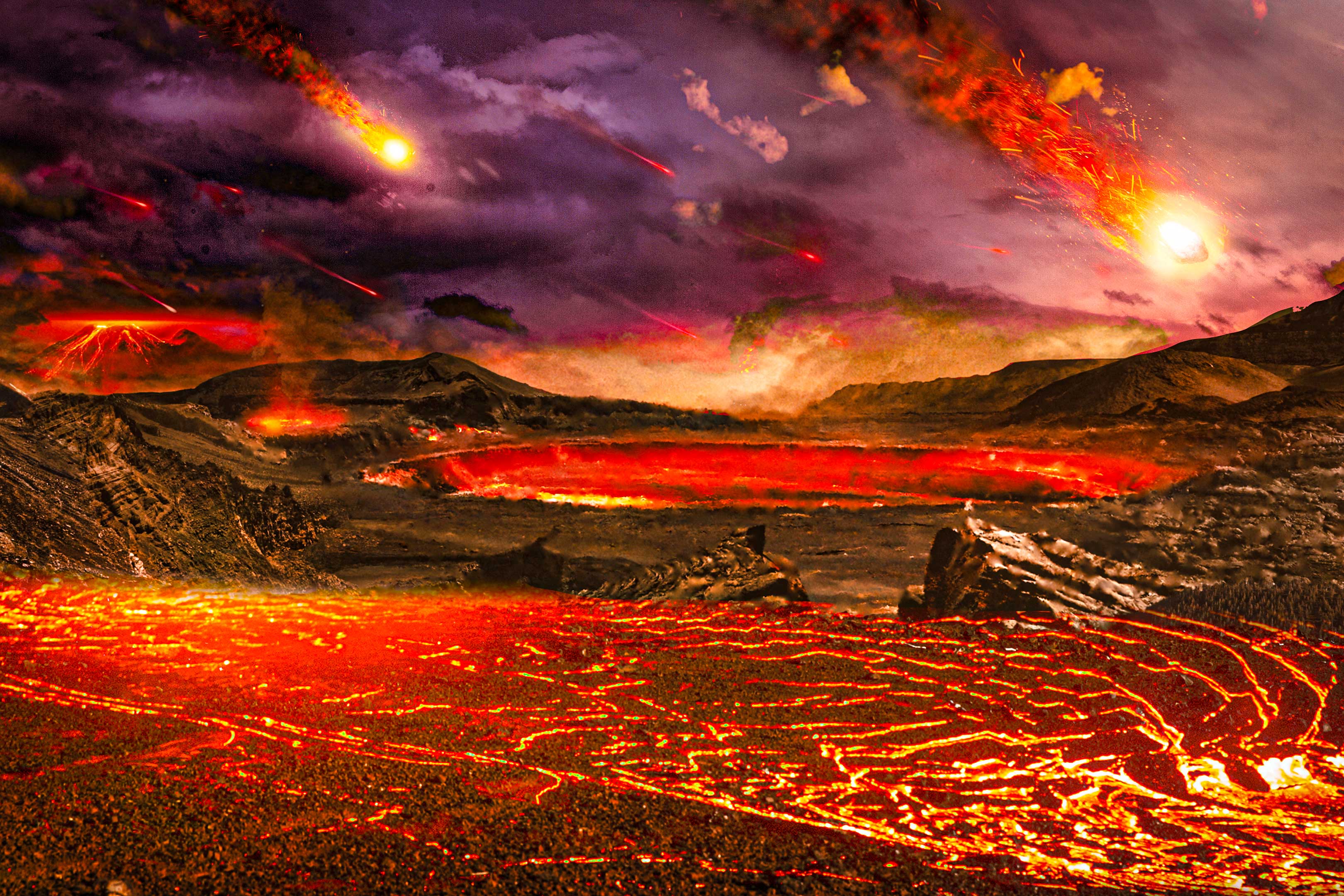
In this earliest phase, Earth was likely rocky and bubbling with lava. Then, less than 100 million years later, a Mars-sized meteorite slammed into the infant planet in a singular “giant impact” event that completely scrambled and melted the planet’s interior, effectively resetting its chemistry. Whatever original material the proto Earth was made from was thought to have been altogether transformed.
But the MIT team’s findings suggest otherwise. The researchers have identified a chemical signature in ancient rocks that is unique from most other materials found in the Earth today. The signature is in the form of a subtle imbalance in potassium isotopes discovered in samples of very old and very deep rocks. The team determined that the potassium imbalance could not have been produced by any previous large impacts or geological processes occurring in the Earth presently.
The most likely explanation for the samples’ chemical composition is that they must be leftover material from the proto Earth that somehow remained unchanged, even as most of the early planet was impacted and transformed.
And later:
[Nicole] Nie and her colleagues discovered that the meteorites they studied showed balances of potassium isotopes that were different from most materials on Earth. This potassium anomaly suggested that any material that exhibits a similar anomaly likely predates Earth’s present composition. In other words, any potassium imbalance would be a strong sign of material from the proto Earth, before the giant impact reset the planet’s chemical composition.
And like a lot of these articles the papers title and abstract is clearer, at least to me:
- Potassium-40 isotopic evidence for an extant pre-giant-impact component of Earth’s mantle
- 14 October 2025
-
Earth’s bulk composition has elemental and isotopic characteristics that cannot be fully reconciled with a mixture of known primitive meteorite compositions1,2,3. One potential explanation for this is that the proto-Earth accreted materials with isotopic signatures distinct from those accreted after the Moon-forming giant impact. Here we report high-precision mass-independent potassium isotopic measurements from thermal ionization mass spectrometry of terrestrial rocks from various ancient and modern sources in the crust and mantle that we argue are consistent with this explanation. Specifically, we found that some mafic Archaean rocks derived from the Hadean–Eoarchaean mantle (including samples from Isua, Nuvvuagittuq and the Kaapvaal Craton) and certain modern ocean island basalts (from La Réunion Island and Kama’ehuakanaloa volcano, Hawaii) exhibit an average 40K deficit of 65 parts per million compared to all other terrestrial samples analysed. The deficit distinguishes these samples from the bulk silicate Earth and any known meteorite group and cannot result from magmatic processes. Therefore, we propose this 40K deficit represents primitive proto-Earth mantle domains that largely escaped mantle mixing after the giant impact and exist in the present-day deep mantle, contributing to some modern hotspot volcanism.
Good explanation but if I can TL;DR something here that is basic but a lot of geologists don’t explicitly introduce as context to lay people because they are silly…
Think of earth as a lava lamp where hot goop rises to the surface and cools into new surface area at mid-ocean spreading ridges and is shunted along the conveyor belt of plate tectonics along until being forced back down underneath another plate and recycled back into goop.
Material is recycled this way, what is significant is this might be a sample of OG earth goop and it might suggest some of the OG earth goop doesn’t mix well with modern earth goop and it might influence modern indigestion in earth as in Hawaii or Yellowstone type stuff.
Remember, we are talking about goop in a lava lamp here, ostensibly it is always mixing so somehow finding a bit of goop that has remained isolated in composition for a long time is going to be fascinating to big lava lamp nerds.
Oh, none of that was me. It’s just quotes
The article does add a little context like this that paper misses but I don’t remember it covering quite this or quite as well. Thanks for the addition
Is it reasonable to call one of the two planets before the impact, Earth? I’d argue the two planets mixed together formed Earth (and the Moon).