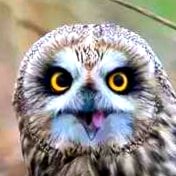


Here we are, at the end of the first set of matchups already! We are finally up to the round where our returning champion makes its return to our games after a year of glory!
Saw Whet was a surprise winner for a lot of us last year. Its uncanny ability to go from unbelievably sweet to small yet scary captured your hearts, and a big win in last year’s games. Let’s review who the Saw Whet is!
Saw Whet comes from large expanses of conifer forest in lower Canada and down the Alaskan and PNW coasts, the Rocky Mountains, and a few spots in Mexico. During winters, the ones in colder territories will migrate south to follow food to less extreme climates.
The name may sound a little odd at first. If you’ve heard of a whetstone, that is the same base word. Whet means to sharpen, and the people taking timber from the forests when they encountered this owl though its little poot poot poot call sounding like someone sharpening a saw blade.
This is a small owl, about 7 inches / 18 cm and a weight around 3 oz / 80 grams. Unlike many owls of similar stature, the Saw Whet is not a fan of insects, and eats almost exclusively small mammals like voles. Despite being fierce predators, their tiny size leaves them open to predation by hawks and larger owls.
Speaking of larger owls, the champ’s competition today is the biggest owl in the world. Considered a top tier god to some of the native people of Siberia and Hokkaido, the Blakistons Fish Owl is one hefty beast. This owl is a genetic bridge between the Bubo owls (primarily the Eurasian Eagle Owl) and the Ketupa owls (Brown, B Tawny, and Buffy Fish), leading to ongoing debate if Ketupa should be classified together with Bubo or not.
Concerning size, these owls are big in every proportion. Up to 28 inches / 72 cm tall and the larger females weighing in at up to 10 pounds / 4.6 kg, this is one mighty bird, especially stacked up against Saw Whet, as demonstrated by yesterday’s post of the Saw Whet next to the Eagle Owl, which is typically smaller than the Blakistons.
Anatomically, BFO is more similar to eagle owls in things like beak and talon design, though it has the floppy plumicorns of the fish owls. It also has some plumage markings similar to the Great Horned Owl of the Americas, whose generic origin is also a bit of a mystery. All this mashed BFO very interesting to continue studying as we learn more about owl evolution.
BFO has an unsurprisingly bassy HOO-hoo call, which is lower in pitch than an Eurasian Eagle Owl, but not as loud.
Bring tied to rivers that don’t freeze during extreme winters while also needing very old forest with large enough trees to support them, the Blakistons is limited in territory where it can live, and it’s harsh enough that I til recently it has been hard to learn about these owls due to the dangers involved.
They catch pike, catfish, trout, and salmon, with reports of some fish being 2-3x their size, and they hold onto tree roots with one foot while pulling in the fish with the other! The average fish size in one study was more expected 2 pounds / 1 kg. They will also eat things like marten, rabbits, and fox.
We’ve had a few great pairings of opposites so far, but I don’t think any have been quite as extreme or between two such popular owls as these two. One is so small and charming, the other, the mighty king of owls. I can’t wait to see how this turns out! The reigning champ, or the mightiest of all the owls?
BFO! BFO! BFO!
Cute is so last year…
I thought this was going to be fairly easy for the Saw Whet, but here it is in a tie…