

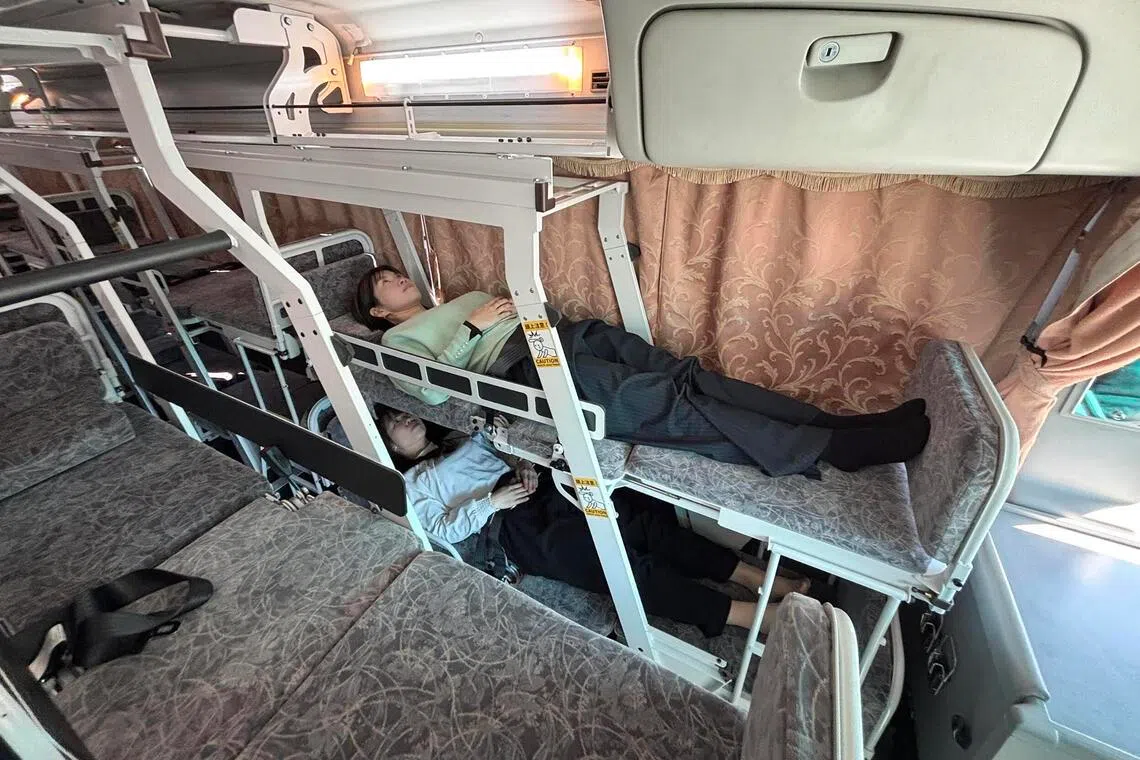
This is a recipe for disaster. They’ve been outlawed in my country (likely EU wide) since the fatality rate in an accident is extremely high. I don’t think they found a way to reduce this in the last decade or so.See my new comment, two serious sleeping bus accidents might have been politicised a bit with a lack if data backing it up. Not like that’s ever happened before…
Pretty interesting concept though. But interesting, the fatality rate is high? Where can I read more on this?
Turbs out the fatality rate might have been exaggerated a bit. I found this Danish article: https://cepos.dk/artikler/medforte-forbuddet-mod-sovebusser-reelt-en-forvaerring-af-trafiksikkerheden/
CEPOS is a slightly biased institute in Denmark, but I trust the data provided in this article. I was only a kid back when the ban was enacted, but it makes sense for me. I’ll adjust my initial comment.
Here's an LLM translation
Did the ban on sleeper coaches actually worsen road safety?
12 June 2019
About 15 years have passed since two Danish sleeper-coach accidents led to a substantial tightening of rules both domestically and abroad. After the accidents several politicians called for improved safety to avoid repeats. Since then the regulations were tightened to such an extent that sleeper coaches have disappeared from the market.
How unsafe were sleeper coaches?
The question is whether politicians actually improved road safety or merely shifted fatalities to other transport modes.
There is no doubt that travelling by a conventional bus is far safer than travelling by car when measured per kilometre travelled. The figure below is based on data from “Risk in traffic 2007–2016”, Christiansen and Warnecke (2018) from DTU Transport. The figure shows that the risk of being injured in a bus is about one-tenth of the risk in a car. That is the same factor the European Transport Safety Council found in 2004.
However, there is a difference between being seated and belted in a seat and lying down lengthwise in a sleeper coach. So how unsafe were sleeper coaches really?
Before the new rules were introduced, roughly 400,000 Danes used sleeper coaches annually when travelling on holiday to southern Europe. In total Danes travelled about 1 billion km in sleeper coaches (approximately one third of those kilometres in a lying position). Based on the accident risk from the figure above (which applies to all buses, including slow-moving city buses), one would therefore expect just under three fatalities or serious injuries per year in these coaches.
I have not been able to find sources listing historical fatalities specifically for sleeper coaches. TV2 wrote in 2004 that “accidents with sleeper coaches are relatively rare compared with, for example, car travel.” The fact that the two 2004 accidents (see box) received so much political attention suggests they were rare events, which is also confirmed by statements from the travel industry. For example: “We rarely see fatalities in connection with bus accidents. However, every year we see cases …”
It therefore cannot be readily dismissed that sleeper coaches were not more dangerous than other buses. Clearly, if you are in an accident it is advantageous to be belted. But the risk of having an accident may differ for sleeper coaches (for example there is less traffic at night, and sleeper coaches typically have two professional drivers).
After the first accident the Danish Road Directorate (Færdselsstyrelsen) recommended requiring safety partitions between all sleeping berths. With such partitions the Road Directorate assessed that a sleeper coach travelling at 80 km/h would be, from a safety perspective, on the same level as a bus travelling 100 km/h with passengers seated and belted. In Germany, where the Danish sleeper coaches mainly operated when used with sleeping berths, the speed limit for sleeper coaches was 80 km/h (and 100 km/h when the bus was used otherwise).
Did politicians improve our road safety?
Despite the Road Directorate’s assessment that sleeper coaches could be made as safe as regular buses for passengers, the rules were further tightened—especially abroad. In Germany the end result was ultimately a ban on sleeper coaches. It was particularly that German ban that stopped the use of Danish sleeper coaches, since the coaches primarily functioned as sleeper coaches while passing through Germany.
The new rules effectively ended the use of sleeper coaches, and this was followed by a very large decline in bus passenger numbers. Trier Ski Travel experienced a 60% drop in bus travellers, but on the other hand a large increase in self-drive holidays.
You can get a hint of the overall effect on road safety by assuming that those who no longer travel by sleeper coach instead drive by car or fly. If we take Trier Ski Travel’s statements as a starting point, 60% of coach trips were shifted to other modes of transport while 40% continued to travel by (safer) buses. As said, the data are sparse…
(End of translated excerpt — the original article includes a box with details of the 2004 accidents and references to the DTU report and other sources.)
Ugh, LLMs… I’ve grown allergic to that term.
Better than calling it AI :p
But it was the easiest way for me to provide the article in a readable format for most people.
That’s a decent application of the technology. It’s still prone to make mistakes, but at least it’s being used for language.
Yeah. I hate how LLM’s have been shoved into absolutely everything and I’m far from an advocate of the technology, but there’s a few use cases where it makes sense. Any translator today is likely a specialised LLM. I do make sure to label it every time I use it.
From like a logical point of view, if you lay down with your feet towards the front, this seems like it would be extremely safe.
Chances are, you won’t get decelerated too strongly in a bus either way, because of inertia, but if you do, you’ve got the friction of your whole body to hold you in place. And if you do shoot forwards, you can put your feet against the front divider, so worst-case you’re gonna break your legs, which is unlikely to be fatal.I think the proplem is with the head. As far as I remember you were only belted in the, uh… Belt region (if at all, old sleeper busses didn’t have belts), so the head was free to fly up and hit the bed above you or the window. Same thing would of course happen in a seated position, but due to the position, fewer limbs come flying and can hit stuff.
But I’m no researcher, this is just what makes sense to me based on the data provided.
Damn, if only i could trust the accuracy of this translation.
I’ve read the Danish and the translated version. Google Translate also uses LLM’s, just FYI.
“Google does it so that makes it okay” is not the flex you think it is.
Considering city buses don’t typically have any restraints and in fact will have half of the passengers standing up if it’s full, how is this any worse?
City busses usually go 30km/h, up to 50 on longer stretches. With a normal biker topping around 30, 35 if they’re fit on a good bike, it doesn’t provide a worse fatality rate as far as I see. When packed you’re also cushioned by other people and the bus being heavy makes it not crash violently in a fender bender or anything but a serious concrete building.
But that aside, I dug up a research article you can check in my other comment. Turns out the two serious accidents causing the ban was politicised, so maybe newer technology can make up for the lacking protection naturally offered in a seated and belted position.
City busses usually go 30km/h, up to 50 on longer stretches.
The ones in Seattle will take the freeway depending on the route. So that’s 100kph.
That sounds worse. In Denmark with maybe only few exceptions I think all highway travel is done with regional busses with limited or no standing space.
Take it away Ern!

this but on wheels
I saw this and I don’t know if I could do 10 hours in that thing. All for it existing for the people who can! (I’ll be on the train instead)

