
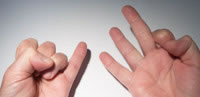
YSK You can count past 1,000 on your fingers by using binary, instead of just 10
With just one hand, you can count to 31, and with both hands you can reach a whopping 1,023. This is because the placement of the held up fingers matters, rather than the amount.
It can be very useful in everyday use, being able to count to huge numbers when you don’t have your phone or pen and paper nearby.
This reminds me of an engineer ever walking me through a bringup test of a board and telling me to flip some dipswitches so that it added up to some binary number and I just stared at him like can’t you just tell me which dips to flip
try 132
This is cute but not practical.
Memorising all 2^n for 0≥n≥10 (1, 2, 4, 8, 16, 32, 64, 128, 256, 512, 1024) is reasonable, but you’ll need to add a lot of them at the same time to convert the counting in your hands to a base 10 number (that’ll use elsewhere). Stuff like 256+128+64+8+2+1; it isn’t difficult but laborious, you know?
Plus the gestures can be sometimes awkward, depending on how flexible your hand is. For example, at least for me it’s a bit tricky to lift the ring finger up without either the middle or the pink.
I have a different strategy to count large numbers by hand. It’s up to 12 with one hand, 144 with both. But it feels comfortable, and rather intuitive:

Put the tip of your thumb on the indicated places to count 1, 2, 3… 12. With one hand; if you want to count past 12, use the other hand to count dozens (12, 24, 36… 144).
Provided you memorised the multiplication table for 12, for any given number you’ll perform at most a single addition, like 84+7 or similar.
(I have a suspicion the Sumerians counted this way with one hand, and one finger per dozen with the other. That’s why a lot of their units 5*12=60 as a basis.)
I have the gene where my second thumb joint/knuckle near the base doesn’t bend. I can only count to 10 using this method. 11 and 12 are not really reachable. Even 9 is a bit of a stretch.
Worst hypothesis, even if counting just to 8, you’re still using a single hand, so it’s an improvement over counting to 5 with fingers. Couple it with the other hand and you’re counting up to 64.
There’s also the Chisanbop method @[email protected] mentioned, for that your unbending joint shouldn’t be an issue, and it allows you to count to 9 with a single hand (99 with both).
I’m a fan of Chisanbop
You can even count to 59k using ternary, introducing a third, half-raised, finger position.
Sure , this is neat, but counting single digits on digits is easy for people.
Mentally adding 16 to 8 and 4 is where people will find this more complex, especially if you have easy stuff like 7+5, you have to do the math in your head to move it from 4,2,1+ 4,1 to 8,4.
11 is extremely hard for me.