

- cross-posted to:
- [email protected]
- cross-posted to:
- [email protected]
As Western European elites scramble to maintain influence amid waning backing from the Trump administration and growing domestic opposition to pro-militarization, anti-people policies, countries in Eastern Europe are faced with a different set of dynamics.
Starting from distinct political and economic conditions, movements across the region are organizing against expected cuts and deepening ties with Israel’s genocidal regime, while also pushing back against local elites seeking to profit from the EU’s expanding armament agenda. Peoples Dispatch spoke with Oana Uiorean and Vlad Mureşan of the Elbit OUT! campaign in Romania about the specific challenges facing left movements in the region and efforts to build strong Palestine solidarity campaigns in Eastern Europe.
Peoples Dispatch: Let’s start with one of the defining issues of the year – militarization. A lot has been said on the war drive in Western Europe, but Eastern Europe has figured less prominently in this discussion. From your perspective, what are the main trends you’ve observed in Romania, and more broadly in the region?
Vlad Mureşan: I think this is still a developing situation. In many ways, it’s quite unclear what’s actually happening, especially in Romania but also across Eastern Europe more broadly. We’ve seen these declarations coming from Western Europe, moving in a jingoistic direction. For example, that Germany is prepared for war, and some Eastern European states have claimed the same. But my sense in Romania, and in much of the Balkans, is different. Here, the dominant feeling has been about integration with the rest of Europe and access to the money that’s in play, rather than a sense of imminent doom.
It looks like these countries want to pay their dues to remain part of the periphery of the US imperial system. We can see this in the companies moving in: familiar American firms, Israeli companies, and now even South Korean ones positioning themselves to benefit from this funding. This is being sold politically as a form of reindustrialization through military spending. But when you look closely at what’s happening on the ground, there is very little actual local development so far.
I think this pattern is present across the Balkans. Greece is a good example: they’re planning major investments in Israeli military equipment, partly because of their historical conflict with Türkiye and the logic of “the enemy of my enemy.” Albania is also deeply tied to Israeli military systems.
So yes, there’s a lot of money flowing in, and the political class is trying to benefit from it. But judging by how investments are being made, it doesn’t really look like real preparation for war. At least not yet.
Oana Uiorean: I agree. I don’t live in Romania anymore, so I’m observing from the outside, but knowing my people and the cultural inclinations, I think many people quietly assume that this is not for real, that the war isn’t really going to come. The idea among the various capitalists seems to be: we’ll take the money and benefit from it. There may be some friction between local and global interests, but in the end, local interests will again lose out, also because the local bourgeoisie is very disorganized. I agree that in this case we’ve largely accepted our usual role as a vehicle for extractive interests.
This is reflected very clearly in what our president said after the most recent European Council meeting, where leaders agreed on allocating €90 billion more for Ukraine through joint borrowing. There was debate about using frozen Russian assets versus joint debt, but Belgium blocked the assets option, so joint borrowing prevailed.
From a working-class perspective, this makes little difference. Either way, we end up more indebted. I don’t see any reason to celebrate Belgium’s move here. But our president’s reaction really summed it all up: he said that either option would have been fine. In other words, Romania went in without a position of its own, without defending any national or social interest, just ready to serve others’ priorities, as usual. This trajectory has been present since Romania joined NATO – probably even before NATO membership was finalized.
And now we’re also hearing from Brussels that the so-called SAFE mechanism is oversubscribed, with countries applying for even more funds. That means even more borrowing ahead, mostly driven by the arms industry.
One thing that will be interesting to watch is how it goes with Hungary, Slovakia, and the Czech Republic. They’ve openly taken a different path in the recent Ukraine funding discussion, and I’m curious whether that will somehow expand, especially in Central and Southeastern Europe. I don’t expect much from Romania, but Bulgaria, being further from Ukraine, might be a more interesting case.
PD: In this context, Eastern European governments will be signing on to militarization while also planning deeper austerity and worsening working conditions. How are these two processes evolving in parallel? Are they trying to justify massive military spending alongside cuts to health, education, and social services at all?
OU: I don’t think they’re really trying to justify it at all. At the mainstream level, the two issues are kept completely separate. There is noise coming from below, of course, from organizations like ours, but not much from other actors. The trade unions are very weak on this. They’ve basically chosen the line of: okay, militarization is happening, so let’s at least try to get some of the benefits for our members. They’re not opposing it; instead, they’re maybe arguing that austerity should be softened by taxing the rich.
This is very similar to what we’re hearing from parts of Die Linke in Germany: “Fine, we’ll militarize, but don’t tax workers – tax the rich.” That’s a frustrating position, because it’s simply not how it works in practice.
In Romania, austerity is continuing at full speed. There’s no pause, no reversal. This has also been a record year for mass layoffs, driven largely by energy prices, and that situation is likely to get worse.
VM: I think there’s a very concrete effort not to connect these two issues. There was one rare moment when the Romanian president slipped and said openly that we need to invest this money, but since we’re in a recession and don’t have funds, it will have to come from other areas, like health and education. That was very rare.
Normally, anyone who makes that connection, even just by asking where the money is coming from, is immediately labeled a Putinist. The narrative is that we must prepare for a coming war, even though nobody can really explain what this war is supposed to look like.
If you look at Romania’s recently published National Defense Strategy, it’s striking how empty it is. There are no concrete plans, no real explanations. The same goes for the SAFE loans: what Romania has applied for is secret, so nobody knows what the country is supposedly preparing for. We also don’t know what Romania has actually sent to Ukraine. Anyone who asks, even just from a transparency standpoint, is shut down.
This pattern goes back to the beginning of the war in Ukraine, and even earlier, to the pandemic. Since then, there’s been a cycle of silencing any kind of debate, whether critical or simply legitimate.
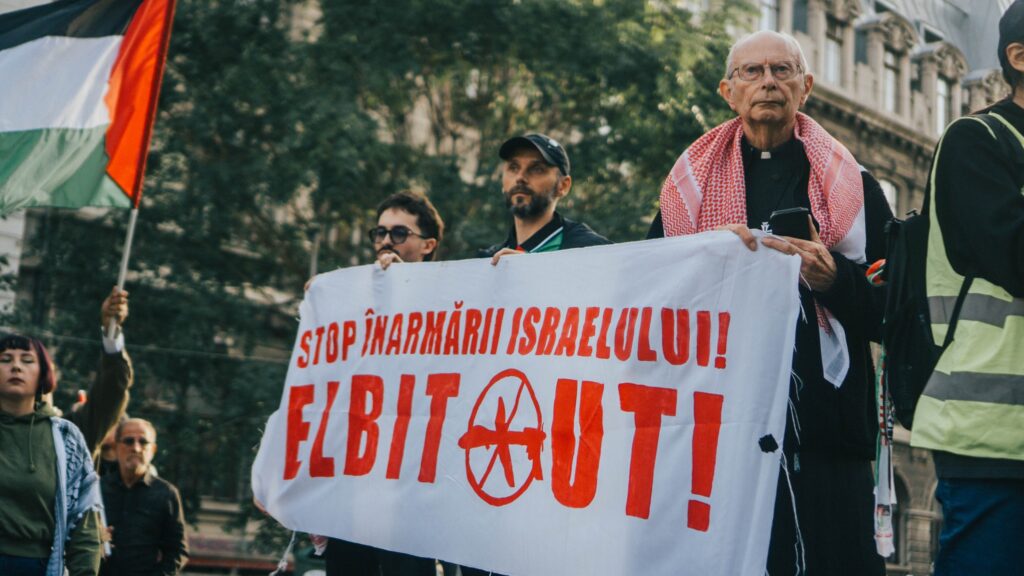
Vlad Mureşan (middle) during Palestine solidarity demonstration in Bucharest. Source: Palestine solidarity Cluj-Napoca/Facebook
PD: When it comes to opposing militarization and austerity, is there any real hope right now? Do you see the potential for resistance among movements or the broader public?
OU: As long as the major trade unions don’t join in, as they’re doing in parts of in Western Europe, nothing is going to happen. We’re obviously pushing back, and there are other organizations and groups – maybe not even comrades, but at least aligned with us on this issue – but there is no real organizational backbone.
In Romania, the only concrete form of workers’ organization is the trade unions, and the vast majority of them are reactionary and not militant. Their analysis has led them to conclude that they should be part of the distribution of war profits rather than oppose the process itself.
At the political and parliamentary level, the main opposition force is the populist right. They’re leading in the polls and are well represented in parliament. But they’ve clearly shifted toward supporting militarization. They’ve significantly toned down the peace rhetoric that helped them gain support during the election period.
VM: That’s true, especially at the leadership level. There are still sections of the populist right that maintain an anti-war, anti-armament position, particularly within the SOS party, which is further to the right of the other populist formations. They still articulate a discourse against war and militarization.
But if you look at their base, it’s more complicated. The populist right has become the only political force that still uses any kind of popular or social rhetoric. All other parties have abandoned that entirely. As a result, their support base is very mixed, very complex. Many people aren’t supporting far-right parties because of nationalism or because they identify with their extreme ideas. They support them because they see them as a reaction to mainstream politics. That’s why you see a lot of discontent at the base level, including calls to take to the streets and organize against what’s happening.
At the same time, these parties have proven ineffective, even as they top the polls. You could see this clearly in the Bucharest elections, where they could have won easily but were undermined by internal divisions. So overall, the situation is very fragmented.
OU: In many ways, this would be the perfect moment for a pro-peace, Euro-critical, socialist movement to come together. That’s precisely why we’re seeing an escalation in anti-communist propaganda and new legislative initiatives to ban communism. Unlike previous attempts, there’s now a real risk that these measures could pass, because the populist right appears ready to move toward the center on these issues. So yes, this is a moment full of contradictions. There’s enormous potential to build something new at this moment, and I expect we’ll be seeing some great struggles and a lot of repression.
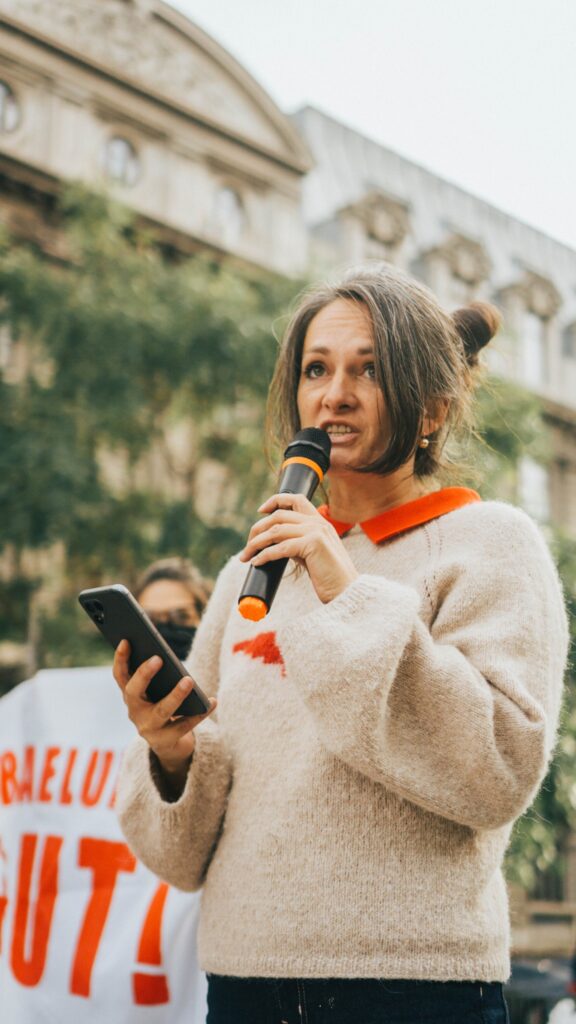
Oana Uiorean during Palestine solidarity demonstration in Bucharest. Source: Palestine solidarity Cluj-Napoca/Facebook
PD: A few months ago you launched the “Elbit OUT!” campaign to counter the company’s presence in Romania. When discussions focus on European complicity in the genocide, attention usually stays on Western Europe. But your work highlights Israel’s growing presence in Eastern Europe, and Romania in particular. Could you describe what you’re seeing on the ground?
VM: I think that over the past two or three years, Israeli presence has grown nearly everywhere. It’s striking how Israeli influence appears across very different countries – Romania, Serbia, Albania. They are effectively implanting themselves across Eastern Europe. Bulgaria might be the only exception where they haven’t fully secured a foothold yet, and even there, it’s mostly because of stronger competition from other countries. Still, Israeli companies are trying to push in there, too. They participate in almost all state tenders.
A well-known case in Bulgaria also involved Elbit financing a highly revisionist book about Bulgaria’s role in the Holocaust. The book promoted the idea that the Bulgarian government “saved” Bulgarian Jews by forcibly conscripting them into the army and into labor camps. And this thing was actually financed by Elbit as part of its effort to enter the local market.
A few weeks ago, Elbit Systems invited a group of Romanian journalists to Israel. They toured factories and were also taken on a field visit near Gaza. The reporting that came out of that trip, especially from the Gaza border, was horrible. But what was significant is that, for the first time, Elbit openly admitted that it wants to use its subsidiaries in Eastern Europe to access EU security funds.
Annual reports from Elbit and other Israeli companies already show that Europe is next to becoming their largest market after Israel itself. As the genocide slows down, in the coming years, Europe is likely to become the main market for Israeli arms. This means long-term dependency. Because when you buy military equipment, you don’t just buy a single product, you buy into an entire system. Contracts run for years, upgrades follow, and states become dependent on Israeli technology. That dependency translates into political impunity for Israel, which helps explain why countries like Romania consistently vote in Israel’s favor.
Israeli companies also have a competitive advantage: their weapons are “field-tested,” cheaper, and extensively marketed. Everyone has heard about Iron Dome and its supposed successes. That makes them very hard to compete with.
OU: In addition to the journalists, there were also military experts invited to Israel for a seminar titled something like “Lessons from the War in Gaza.” Romania was very well represented. I think we should also all keep track of the situation in Moldova. It’s not an EU member, but cooperation with Israel is clearly growing there as well.
PD: Looking ahead to 2026, are there specific countries, sectors, or forms of cooperation where Israel’s role in Europe might become especially significant?
OU: Well, just today, Belgium adopted a new defense procurement law. From what’s been reported, it removes due-diligence requirements for joint procurement under mechanisms like SAFE. This is important because SAFE will likely rely on it. Several member states will procure together, and there will probably be exception clauses. The effect is that everything can pass through Belgium, which will no longer check where equipment comes from.
VM: But honestly, I don’t think most countries conduct meaningful due diligence anyway. We’ve tried to investigate this here. Romania actually publishes relatively detailed reports on military imports and exports – often late, but still public. We repeatedly asked how export licenses are assessed. According to the Arms Trade Treaty (ATT), which Romania has signed, licenses should not be granted if there’s a risk weapons could be used in war crimes.
So we asked: how is this due diligence actually carried out? At the very least, there is suspicion about what’s happening in Israel. Even without calling it genocide, the suspicion alone should trigger safeguards. But authorities never disclose anything. We’ve never been able to get answers. That’s why we’re considering legal action next year to challenge the process.
The deeper problem is structural. Romania is a signatory to nearly every arms transfer treaty, but enforcement is entirely national. There’s no external superstructure. Romania verifies itself, making the system essentially useless.
OU: In Belgium, civil society pressure is strong, so authorities are trying to shield themselves legally by removing accountability mechanisms. In Romania, they don’t even need to bother. Organized opposition barely exists. That’s why it is so attractive to Israel and other arms producers. The local bourgeoisie is fragmented, easily bought off, and unable to articulate collective interests. The same pattern exists across much of the region. Bulgaria may be an exception mainly because prolonged political instability has slowed everything down, which, in this case, isn’t entirely bad.
But more broadly, Western Europe is seriously underestimating how much Eastern Europe functions as a gateway for Israel to Europe. People here are talking about sanctions and cutting funding, but I think they don’t fully understand the actual material conditions that make Israeli integration into Europe possible. This is a major blind spot.
From a dependency theory or neocolonial perspective, this makes complete sense. Eastern Europe is the exact point you want to be to access Fortress Europe. Because it’s porous. Because the local bourgeoisie is comprador in character and can be bought by the highest bidder. Because the population is on its knees, weakened by decades of extraction, massive emigration, and social collapse. And many of us who would otherwise organize locally are part of the diaspora.
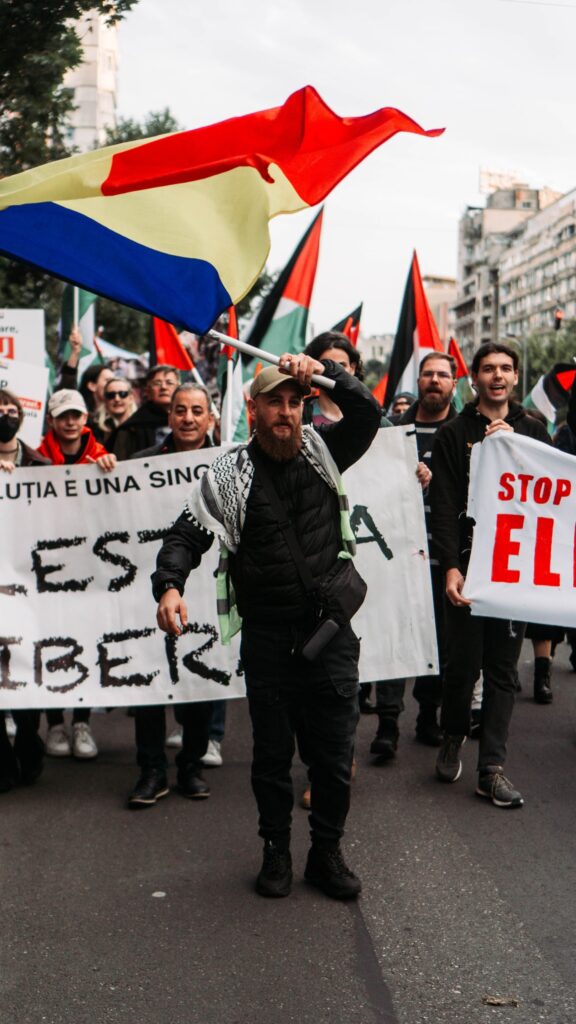
Source: Palestine solidarity Cluj-Napoca/Facebook
PD: To close, I wanted to ask about building resistance and Palestine solidarity in Eastern Europe, and especially in Romania. Given everything you’ve described, this is clearly not an easy context. How is the campaign developing?
VM: In some ways, it’s actually quite easy, because the campaign is very concrete. When we usually talk about Palestine, the genocide in Gaza, and the occupation, many Romanians are skeptical. Some don’t really know what’s happening. Others feel empathy but say, “This is far away, Romania has no connection to it.”
This campaign makes that connection obvious. It shows clearly that Romania is involved. That makes it much easier than previous campaigns we’ve tried to run around multinational corporations, which tend to be abstract and present everywhere. Elbit’s presence in Romania is very specific and very direct.
What’s difficult is building a movement in a context where we’re still very isolated. We’re trying to connect with the labor movement, but it’s dominated by three or four major unions. Their position is very clear: they don’t want to do politics. They only want to negotiate contracts and refuse to go beyond that.
There are some independent unions that are more flexible and more open-minded. They understand that many of the gains workers make are immediately eroded by inflation, the cost of living, and broader economic mechanisms beyond the workplace. They recognize the need to go further, but they remain quite a minority.
So in many ways, we’re building this almost from scratch. It’s a slow process. We also need to link Palestine solidarity more clearly with the broader issue of militarization, because that connects directly to people’s lived experience. But this will again take time.
At the same time, we’ve been in the streets for more than two years now. We’ve had tens of thousands of conversations. People do resonate with the message. The real problem is organizing. There’s a huge historical gap in Romania when it comes to building movements that aren’t led by small, elite, or outright reactionary forces.
OU: I agree, there’s definitely a long road ahead. I also wish we had more support from organizations in Western Europe that are better organized and have more experience. They’ve had decades to build these movements. The level of coordination isn’t where I’d like it to be yet.
That said, over the next year, as material conditions continue to worsen, I think more people will start to see the contradictions more clearly. They’ll begin to understand why Eastern Europe matters so much in this picture. But there’s no shortcut. It’s a long process.
The post In Eastern Europe, resistance grows to militarism and Israeli arms production appeared first on Peoples Dispatch.
From Peoples Dispatch via this RSS feed
You must log in or register to comment.