

As the war in Sudan that has unleashed the world’s worst humanitarian crisis nears a thousand days, “a cessation of hostilities, a humanitarian truce going into the new year” is an “immediate goal” of the US, said its State Secretary, Marco Rubio, in his year-end press conference.
Donald Trump, he insisted before the US cabinet earlier this month, is “the only leader in the world capable of resolving the Sudan crisis.”
But only two weeks before, Trump himself had explained that he had no understanding of the war. “I thought it was just something that was crazy and out of control,” he said in his address to the US–Saudi Investment Forum in Washington on November 19. “I viewed it as being just sort of a freelance, no government, no this, no that,” he went on to articulate.
But Saudi Arabia’s crown prince, Mohammed bin Salman (MBS), “explained the whole culture and the whole history,” to Trump on the sidelines of an investment summit, “and it was very interesting to hear, really amazing.”
Over 150,000 have been killed in the over two and a half years of this war that has hurled half the population into “extreme levels of hunger”, as parts of the country are in the throes of the world’s first officially declared famine since 2020. Deadly diseases like cholera stalk the population weakened by hunger, especially the Internally Displaced People (IDPs) who crowd in camps with no sanitation.
Read more: Deadly diseases stalk millions in war-torn Sudan
Even after more than three million people forced to flee amid the war recently returned to their homes, over 9.3 million people remain displaced within Sudan, while an additional 4.3 million refugees have fled to neighboring countries – the largest displacement crisis in the world.
“Sir, you’re talking about a lot of wars, but there’s a place on earth called Sudan, and it’s horrible what’s happening,” Trump recalled MBS telling him. To stop this war “would be the greatest thing you can do,” greater even “than what you’ve already done.”
Goaded by the flattery, Trump committed to work for peace in Sudan, because “I just see how important that is to you, and to a lot of your friends in the room,” he told MBS and wealthy Saudi investors attending the forum.
But until MBS told him “there’s a place on earth called Sudan” and gave him a history and culture lesson during this forum, Trump claimed that Sudan “was not on my charts.”
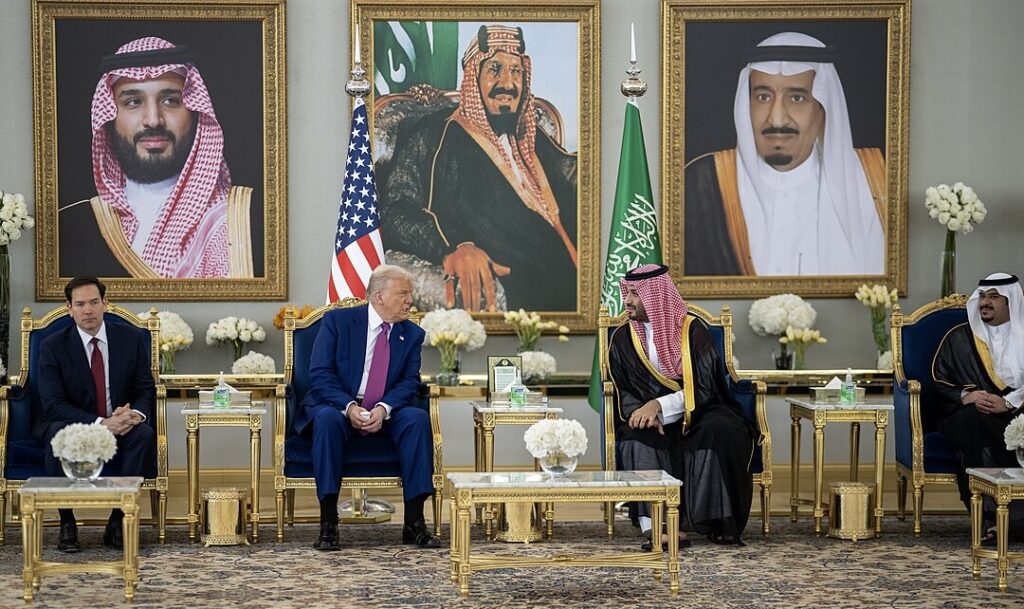
US President Donald Trump on a state visit to Saudi Arabia in May 2025. Photo: The White House
A long history of US involvement in Sudan
It may well not have been on Trump’s chart, but the US state has been involved in Sudan for over half a century, starting with the military coup in 1958, only two years after independence.
It was a part of the Cold War efforts to entrench itself in Sudan to use its territory against the northern neighbor, Egypt, whose government, then led by Gamal Abdel Nasser, had tilted toward the Soviet Union. Nasser, at the time, had “entered into an agreement with Russia to build the high dam – a project the US and World Bank” were eyeing, explained Sidgi Kaballo, a prominent Sudanese academic and central committee member of the Sudanese Communist Party (SCP).
After Nasser died in 1970, the new Egyptian regime, firmly on the side of the US, joined its tripartite military exercises in northern Sudan. These exercises, meant to train US troops in the hot desert conditions to ready them for a potential invasion in the Gulf, continued for nearly a decade from the mid-70s to 80s, under the military rule of Gaafar Nimeiry.
After Islamists came to power under Omar al-Bashir after the 1989 coup, the US designated Sudan as a “state sponsor of terror” in 1993. However, after Sudan began cooperating with the US intelligence and assisting its counterterror operations in the aftermath of 9/11, the US State Department’s Country Reports on Terrorism described Sudan as “a strong partner in the War on Terror.”
However, Sudan remained on the “state sponsor of terror” list until it signed the Abraham Accords in 2020, normalizing ties with Israel after cutting off diplomatic relations with Iran earlier in 2016, aligning with the US-Saudi-UAE axis in foreign policy.
“The US interests in Sudan have been mainly geopolitical,” Kaballo said, adding, even today, it is invested in stopping Russia from securing a military base in eastern Sudan on the Red Sea coast and blocking China’s Belt and Road Initiative from passing through the country.
Land grab under the cover of Liberalization
But the US allies in the region – namely Egypt, Saudi Arabia, and the UAE, which together have formed the Quad that has taken charge of negotiating an end to the ongoing war – have a direct economic stake in Sudan.
The food processing plants in northern neighbor Egypt depend on Sudan’s agricultural produce, especially meat and oil seeds like sesame and groundnuts, not mainly for food, but for export, Kaballo said, adding, it is crucial “for its balance of trade.” Cultivation of export crops and fodder “is a waste of land and water that should be used for producing food crops” to feed the Sudanese people, argued Kaballo.
The scramble is not only for the produce, but for the agricultural land itself. Watered by the Nile, the North African country has the largest acreage of arable land on the continent.
Vast tracts were handed over to foreign countries under the IMF-prescribed neoliberal restructuring, even as the UN Food and Agriculture Organization (FAO) was warning about “worsening hunger and malnutrition crisis.”
Egypt was allocated at least 100,000 acres of Sudanese land for direct cultivation in 2014.
Egypt’s ambition over Sudanese land, however, was dwarfed by the Gulf members of the Quad. Saudi Arabia, which had already acquired over 100,000 acres in 2010, was granted over a million more acres on a cheap lease for 99 years in 2016. Earlier in 2015, the UAE’s Al-Dahra Holding had expressed interest in acquiring 2.4 million acres of land.
December Revolution
However, before completing these large transfers, the dictatorship of Omar al-Bashir was toppled by the December Revolution. What started as protests against the tripling of bread prices on December 19, 2018, snowballed into a mass pro-democracy protest across the country. Sustaining for months despite violent repression, the mass movement forced the ouster of Bashir in April 2019.
Removing him in a coup, his confidants, Abdel Fattah al-Burhan, head of the Sudanese Armed Forces (SAF), and Muhammad Hamdan Dagalo, aka Hemeti, head of the paramilitary Rapid Support Forces (RSF), formed a military junta together.
Refusing to relent, demanding the handover of power to a civilian government, protesters continued to occupy streets and squares. The center of the protest movement was the mass sit-in demonstration by hundreds of thousands occupying the square outside the army HQ through the days and nights for months.
Then, on June 3, 2019, the RSF was deployed to disperse the sit-in. The notorious paramilitary force was formed in 2013 by coalescing the Janjaweed militias used by Bashir’s regime to commit mass atrocities on civilians with SAF’s support during the Darfur civil war in the 2000s.
The US had accused Sudan of committing genocide in Darfur at the time. While disputing the “genocide” accusation, the European Union (EU) had maintained, nevertheless, “it is clear there is widespread, silent and slow killing and village burning of a fairly large scale.”
Nevertheless, in 2015, the very militias committing these atrocities, then organized as the RSF, were deployed on the EU’s behalf to intercept African asylum seekers en route to Europe as part of a USD 200 million migration deal it had entered with Sudan.
The RSF further enriched itself from the three billion dollars payment by Saudi Arabia and the UAE for the deployment of 40,000 of its fighters between 2016 and 2017 for their US-backed war on Yemen, alongside a small contingent of the SAF troops.
This battle-hardened force, notorious for its atrocities on civilians, was then deployed in the country’s capital to evict the protesters outside the SAF’s HQ.
Surrounding their sit-in demonstration, the RSF wounded over 500 and killed over a hundred, opening fire, hacking with machetes, raping, and then dumping scores of bodies, weighed down by the tied rocks, into a stream of the Nile flowing nearby.
Read more: Death toll in Sudan massacre exceeds 100
The New Arab reported that the massacre was unleashed “shortly” after the top generals of the SAF and the RSF visited Saudi Arabia, the UAE, and Egypt, whose interests had been derailed by the December Revolution. Several observers had argued this meant the junta had “received a green light from the three powerful Arab states” to commit this massacre.
Nevertheless, the December Revolution continued, then taking the form of a general strike, with thousands of workers workers staying home, bringing the junta-led state to a halt. They called for a reorganization of the economy to free the industries from the stranglehold of the military elite to benefit the masses of workers and consumers.
The movement also insisted on the dissolution of the RSF and the formation of a single professional national army, subjugated to a civilian government. It further called for the withdrawal of Sudanese troops from Yemen, and a re-orientation of its foreign policy, away from the US-Saudi-UAE axis, and in line with the interests of the Sudanese people.
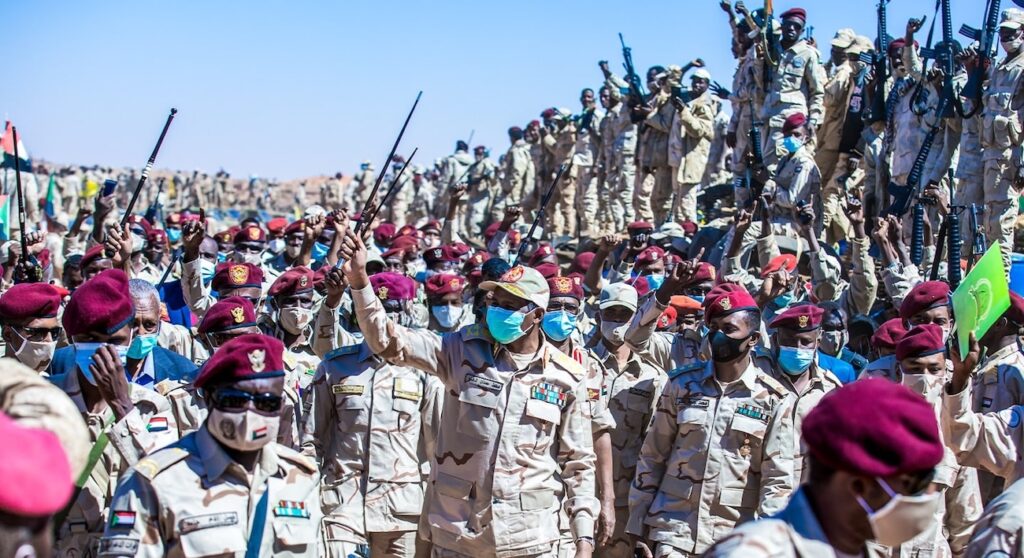
Members of the Rapid Support Forces with Mohamed Hamdan Dagalo at the center. Photo: RSF Website
Undermining these demands, radical for the Sudanese conjuncture, the US and the UK maneuvered diplomatically behind the scenes of the Ethiopia-led negotiations to coalesce together a ‘joint civilian-military transitional government’ in August 2019.
Its civilian component consisted mainly of technocrats backed by centrist and right-wing parties of the Forces of Freedom and Change (FFC), a broad-based civilian coalition formed during the Revolution. Protesting against their compromise with the military junta, the SCP, which had played a key role in the December Revolution, broke away from FFC.
The new government, in which FFC shared power with the junta, was quick to resume dealing in Sudanese land with Gulf powers. Less than a year after its formation, it ceded 100,000 acres to the UAE’s largest publicly traded firm, the International Holding Company (IHC). It was also negotiating a deal to hand over the management of the South Port Container Terminal of Port Sudan to the logistics giant, Dubai Ports World.
Red Sea access
Located on the Red Sea with Saudi Arabia across the water body to its east and a coastline that runs north into Egypt, it is a geopolitically sensitive coastline. UAE, which is further away from Sudan to the east of Saudi Arabia, has a lesser direct geopolitical stake. But, for commercial reasons, it is actively seeking Sudanese Red Sea ports in Africa, explained Kaballo.
However, the government was unable to hand over the terminal of Sudan’s national port in the face of opposition by the trade unions. Resisting privatization under Bashir, the trade unions were a well-organized force in the country and had spearheaded the December Revolution.
Although the civilian face of the government had placated sections of the protest movement, the December Revolution was still a force to be reconciled with on the streets, able to draw hundreds of thousands to demonstrations.
With “the revolutionary forces and the trade unions” standing in the way, the government was forced to retreat, recalled Kaballo. However, the section of the government that was more susceptible to pressure from the streets – the civilian component – was removed in late 2021 in a coup as the SAF chief Burhan and the RSF chief Hemeti concentrated all power in the junta again.
A year later, in December 2022, the junta signed away a vast stretch of coastal land, about 200 km north of Port Sudan, to a UAE-based consortium including its state-owned Abu Dhabi Ports Group and Invictus Investment to develop the Abu Amama port.
The six billion dollar project was envisioned to have an airport, over 400,000 acres of agricultural land, a free trade zone, with a 450 km long road west to the UAE’s vast agricultural project in the River Nile state of Sudan.
Effectively, it was to lay down an infrastructure for a more seamless extraction of Sudan’s agricultural produce to the UAE, while almost a quarter of the Sudanese population was suffering acute hunger at the time.
UAE agribusinesses are also heavily invested in other African countries, including Chad, Cameroon, Central Africa, and South Sudan, added Kaballo. The new port in Sudan was also to serve as the exit point from the continent for the produce extracted from these countries.
Civil war
However, the project could not take off. Only months after signing this agreement, in April 2023, the power struggle brewing within the junta between the Burhan and Hemeti erupted into a civil war with the SAF and RSF turning on each other, unleashing the world’s worst humanitarian crisis in Sudan.
But “this is not simply a war between two generals, but between two wings of a comprador parasitic capitalist class,” fighting each other against the backdrop of a regional and global contest over Sudan’s resources and geostrategic location, argues Kaballo.
Later in November 2024, the SAF-led government, based in Port Sudan after shifting its administrative seat from the capital Khartoum in the early days of the war, scrapped the port deal with the UAE, complaining of its support for the RSF.
But then, the RSF had overrun SAF bases in Darfur, taking over most of the region, except North Darfur state’s capital, El Fasher. Laying siege in May 2024, RSF tightened the noose around the city by building a wall by mid-2025, starving it of food supply, before breaking through its defenses in late-October.
Read more: El Fasher’s last stand: “The city has fallen, but its dignity has not”
What followed was a depopulation of the city, with the RSF massacring its civilians in likely tens of thousands. British weapons sold to the UAE were found to be in use by the RSF in its El Fasher campaign.
Read more: RSF has burnt and buried tens of thousands of corpses in El Fasher, says Yale report
After thus consolidating its control over Darfur, the westernmost region of Sudan, its troops are now advancing east into the Kordofan region, where the center of the fighting has now shifted.
The Gold Rush
Gold illegally mined from Darfur and smuggled to the UAE is a key source of RSF’s income, weapons, and vehicles. Although the largest buyer of Sudanese gold since 2010, the gold from Sudan is not the UAE’s main interest, clarified Kaballo. It adds up to only a “small percent of the UAE’s overall gold trade.”
He added further that the “SAF generals are also big traders and exporters of gold.” The Ministry of Minerals of the SAF-controlled de facto government started talks with the Saudi Gold Mining Refinery amid the fighting earlier in August this year.
“The emerging war economy has seen an increased dependence on the production, smuggling, and exportation of the mineral sector – mainly gold to the Gulf – which is extracted from both SAF- and RSF-controlled territories,” reported S-RM, a global corporate intelligence and cyber security consultant.
The country’s gold production has almost doubled since the start of the war. While the Darfur region, under RSF’s control, “is a significant gold-producing region, the Red Sea State,” under SAF’s control, “stands out as the largest gold producer in the country,” the Swissaid reported.
“Egypt is also interested in Gold,” said Kaballo, adding that unprecedented quantities of gold were exported from Sudan to Egypt amid this war, during which its Central Bank increased its gold reserves.
Sudan is also endowed with copper, uranium, manganese, and rare earth minerals, which the US is trying to acquire from Africa.
Under the cover of peace process
It is these economic and geopolitical interests of the US and its three regional allies that the Quad is trying to ensure, under the cover of the peace process it has initiated, maintains Kaballo. There are competitive and conflicting interests within the Quad. It is these intra-block contradictions that the Quad is taking time to resolve, essentially to reach an agreement amongst themselves on “how to divide the cake,” he argued.
“Since the outbreak of the war, the US administration has not stopped issuing successive statements and holding rounds of negotiations – from Jeddah to Switzerland, and finally to the Quad meetings in New York – in a series of maneuvers that do not conceal their essence: managing the crisis rather than solving it, and controlling its trajectories in a way that serves the American strategy in the region. The farce reached its peak when the US president claimed he would ‘take care of’ the Sudanese crisis based on what he described as the ‘inputs’ and ‘appeals’ of the Saudi Crown Prince,” read an editorial in the SCP’s newspaper, Al Maydan.
“After more than two years since the outbreak of war,” SCP maintains, “it is no longer hidden that the Quad’s initiative is not a serious attempt to end the crisis, but rather an effort to contain its outcomes and re-balance influence in the region.”
Pointing out that “all the principal supporters of the warring parties in Sudan are” US allies, it added, “Washington’s [own] track record in dealing with Sudan proves that” the Quad’s peace process is aimed at “sustaining dependency and facilitating the extraction of resources”.
Nevertheless, the SCP will welcome any ceasefire that might result from the Quad’s initiative, added Kaballo. It is necessary to stop more deaths and supply life-saving aid for civilians in both the SAF and the RSF-controlled territories.
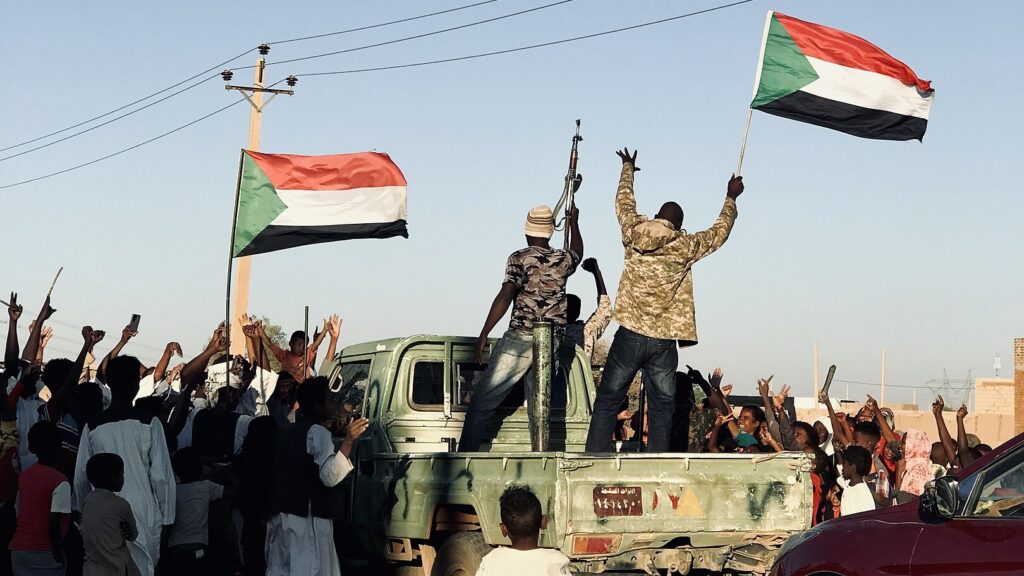
People in the northern rural villages of Omdurman celebrating upon hearing about the liberation of a part of Khartoum by the Sudanese army. Photo: Wikimedia Commons
Moreover, an end to the fighting “will allow” the popular forces of the December Revolution to mobilize once again and take the streets “to defend the interests of the Sudanese people and shape its future.”
War as counter-revolution
Enduring massacres and machinations of a technocratic government with a civilian face, the December Revolution had continued even after the 2021 coup in which the SAF and the RSF consolidated power and intensified repression.
Under the leadership of the Resistance Committees, a decentralized network of activists organized in neighborhoods across the country, hundreds of thousands took to the streets after this coup on a near-weekly basis, facing bullets, batons, tear gas, arrests, and torture. The mass demonstrations continued right up until April 2023, when the SAF and the RSF turned on each other, hurling the country into civil war.
The war proved to be a counter-revolution so fierce that the popular forces could no longer exert power on the streets. The Resistance Committees, which had led the protests, then occupied themselves with organizing relief and rescue for civilians, with survival becoming the central task amid this cataclysm.
Although the Quad cannot bring peace to Sudan, Kaballo is emphatic that any ceasefire to silence guns will provide an opening for the popular forces to resume mass actions to assert the radical path envisioned by the December Revolution to address the structural causes of the war.
However, the forces vested against the December Revolution are many and mighty. “Aborting the path of radical change in Sudan” is a central objective of “American imperialism”, uniting Saudi Arabia, Egypt, and the UAE, despite the conflicting interests amongst themselves, argued the SCP.
To accomplish this abortion, the Quad is resorting to “its old project: a fragile ceasefire, top-down settlements, and a nominal civilian government arranged outside the will of the Sudanese.”
Jockeying at the Quad-led negotiations for their share in this government are the same centrist and right-wing political parties that had entered into a power-sharing agreement with the military junta back in 2019, forming the “joint civilian-military government” that unraveled two years later.
Today, they are positioning themselves to be part of what the SCP describes as an externally propped-up “subordinate civilian regime that guarantees American interests and, after that, the interests of” the regimes in Egypt, Saudi Arabia, and the UAE.
Effectively, it will mean the continuation of the extraction of Sudanese resources, the grabbing of its agricultural land, and geopolitical exploitation to serve US interests.
“In this decisive moment, the real wager remains on the power of the masses and their ability to impose their will and wrest their future from the hands of those attempting to engineer it on their behalf.”
“The path out of the crisis” cannot “be drafted in the rooms of the Quartet, nor in the deals of hesitant civilian groups, but only through a national democratic project grounded in the radical” vision of the December Revolution.
The post The war in Sudan is “between two wings of a comprador parasitic capitalist class” appeared first on Peoples Dispatch.
From Peoples Dispatch via This RSS Feed.